
Class 8 :- Chapter 2 :- Curiosity :- CBSE Textbook Solution
Definitions:
- Cell: It is the basic, fundamental unit of life.
- Cell Membrane: The outer layer of a cell that allows nutrients and waste products to pass through it.
- Cytoplasm: A jelly-like substance found between the cell membrane and the nucleus.
- Organ System: An organ system is a group of organs that work together to perform major body functions.
- Organism: An organism is a complete living being that can carry out all life processes.
- Microorganism: Microorganisms are very tiny living organisms that cannot be seen with the naked eye.
- Unicellular Organism: Unicellular organisms are made up of only one cell. A single cell performs all life activities.
- Multicellular Organism: Multicellular organisms are made up of many cells.
Answer the following:
1) Write the functions of the following:
- Cell Membrane:
- (i) The cell membrane encloses the cytoplasm and nucleus.
- (ii) The cell membrane separates one cell from another.
- (iii) It is porous and allows the entry of materials essential for life processes and the exit of waste and toxic materials.
- Cytoplasm:
- (i) Cytoplasm is the jelly-like substance that fills the cells.
- (ii) It contains other cellular components (cell organelles) and compounds such as carbohydrates, proteins, fats, minerals, and salts.
- (iii) Most life processes take place within the cytoplasm.
- Nucleus:
- (i) The nucleus acts as the control center of a eukaryotic cell; it contains genetic material and regulates gene expression, growth, and development.
- (ii) The nucleus regulates all activities that occur within the cell, including metabolic processes.
- Cell Wall:
- (i) The cell wall in plant cells provides rigidity and strength to the plant.
- (ii) This is why plant cells are arranged compactly next to each other.
Explanations & Demonstrations
Q3) Explain in detail the nerve cell with a well-labeled diagram.
Answer:
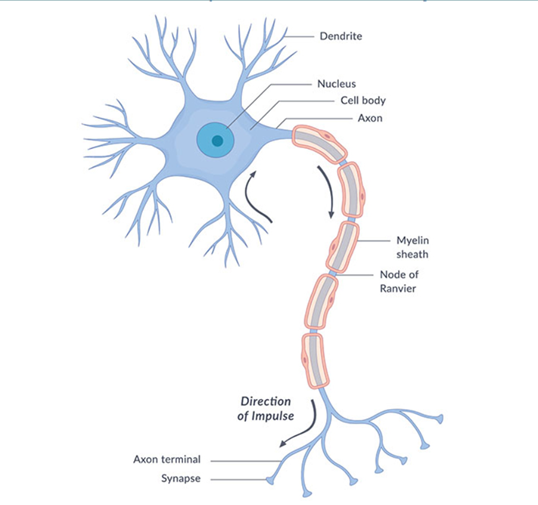
- (i) Nerve cells are the electrically excitable parts of the nervous system that carry messages.
- (ii) Their elongated shape and branched structure help them reach different parts of the body and pass on messages quickly, receiving sensory input and processing chemical signals.
- (iii) They consist of a cell body (soma) containing a nucleus, branch-like dendrites to receive signals, and a long axon to transmit impulses to other cells.
Q4) Explain the demonstration of an onion cell. Answer:
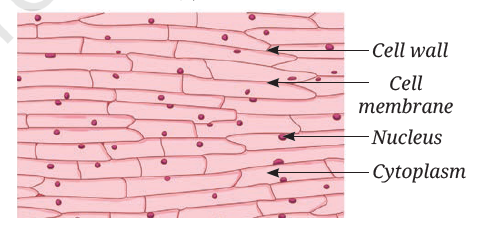
- i) Take an onion bulb from your kitchen or garden and wash it thoroughly with water.
- ii) Cut the onion bulb into vertical pieces.
- iii) Take one piece of onion and pull the thin, transparent layer from its inner surface with the help of forceps. This layer is called an onion peel.
- iv) Place the peel in a petri dish containing a few drops of safranin for 30 seconds. This will give color to the cell and help us see them clearly.
- v) With the help of a thin brush, transfer the onion peel to another petri dish containing water to rinse it and remove extra stain.
- vi) Now, carefully place the stained onion peel on a glass slide using a thin brush, ensuring it does not break or fold.
- vii) Put a drop of glycerin over the onion peel on the slide. The glycerin will prevent the drying of the cells and improve clarity for better visualization.
- viii) Slowly place a coverslip over the peel using a needle so that no bubbles are formed.
- ix) Use blotting paper to gently wipe off any extra glycerin around the edges of the coverslip.
- x) View the slide under a microscope.
Q4) What is a cell? Demonstrate a cheek cell.
Answer: All living beings are made up of cells. The cell is the basic, fundamental unit of life.
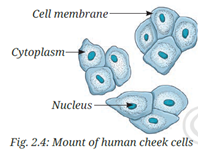
Demonstration of a cheek cell:
- Rinse your mouth with clean water.
- Use the blunt end of a clean toothpick to gently scrape the inside of your cheek.
- Place the scraped material in a drop of water on a clean glass slide and spread it evenly.
- Add a drop of methylene blue over the material on the slide. Adding stain improves the visibility of the material under the microscope by increasing the contrast.
- After one minute, add a drop of glycerin over the material on the slide to prevent the cells from drying out.
- Now, carefully place a clean coverslip over the material and remove the excess glycerin from the edges of the coverslip using blotting paper.
- Observe the slide under a microscope and draw what you see in your notebook.
Q6) Who discovered the cell and how?
Answer: In 1665, Robert Hooke observed many small, empty spaces in a thin slice of cork using a microscope. These empty spaces resembled the structure of a honeycomb. This was the first time the word “cell” was used.
Q7) Do different animal cells also vary in their shape and structure? If yes, how?
Answer: Yes, the muscle cells and the nerve cells of a human vary in their shape and structure. A muscle cell has a spindle-like shape, while a nerve cell is very long and has branches.
- Example: The stomach has different kinds of cells for performing different functions. Muscle cells in the stomach wall help to process food, while other cells produce digestive juices and acids.
Q5) Why is the cell considered to be a basic unit of life?
Answer: A cell is considered to be the basic unit of life because it is the smallest independently functional unit that forms all living organisms. Cells act as building blocks to create complex structures, manage metabolism, and carry out life-sustaining processes like energy production and reproduction.
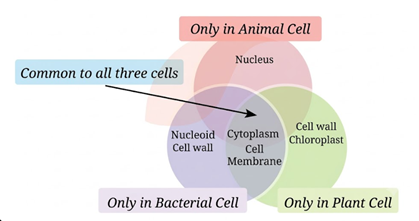
Place the various parts of the cell given below in the appropriate places in the following diagram:
- Neurons
- Chloroplast
- Cell membrane
- Cytoplasm
- Cell wall
- Nucleus
Q3) 3. A farmer was planting wheat crops in his field. He added nitrogen-rich fertiliser to the soil to get a good yield of crops. In the neighbouring field, another farmer was growing bean crops, but she preferred not to add nitrogen fertiliser to get healthy crops. Can you think of the reasons?
Answer: Beans are leguminous crops that have a symbiotic relationship. In their roots, they naturally fix atmospheric nitrogen into the soil, removing the need for an artificial nitrogen fertilizer. Wheat, however, is a cereal crop that cannot fix its own nitrogen. Therefore, it is necessary to add fertilizer to a wheat field.
Q12) Snehal dug two pits, A and B, in her garden. In pit A, she put fruit and vegetable peels and mixed it with dried leaves. In pit B, she dumped the same kind of waste without mixing it with dried leaves. She covered both the pits with soil and observed after 3 weeks. What is she trying to test?
Answer: In this case, the peels decompose more effectively than in Pit B because:
- i) Mixing the waste allows… (Sentence trails off in the original notes)
- ii) Without mixing, the pile can become compact, and anaerobic conditions slow down the process and cause odor.
- iii) Mixing green waste creates a balance of carbon and nitrogen, which helps decompose and break down organic matter quickly.
Identify the following microorganisms:
i) I live in every kind of environment, and inside the gut.
- Answer: You are a bacterium, a single-celled organism that helps in digestion and supports the immune system.
ii) I make bread and cakes soft and fluffy.
- Answer: You are yeast, a single-celled fungus that ferments sugar and releases CO2, which uplifts the dough.
iii) I live in pulse crops and provide them nutrients for their growth.
- Answer: You are Rhizobium bacteria, which live in a symbiotic association in the root nodules of leguminous plants and convert atmospheric nitrogen into usable ammonia.
Q6) Design an experiment to test that microorganisms need optimal temperature, air, and moisture for growth.
Answer: To show that mold requires warmth, air, and moisture to grow, we need the following materials:
- 3-4 slices of bread
- Water
Procedure:
- Take 3 slices of bread and label them as A, B, and C.
- Place slice A near the sink and add a few drops of water on it.
- Keep slice B in the refrigerator.
- Place slice C in a warm place and cover it with a plastic sheet.
- Leave them undisturbed for 3 to 5 days.
- Observe the bread slices after 3 to 5 days.
Observations:
- Slice A: Fuzzy growth of mold -> Due to proper temperature and moisture.
- Slice B: No growth on the bread -> Due to cold and dry conditions.
- Slice C: Less growth on the bread -> Only warm conditions; lack of moisture slows down growth.
Result:
- Microorganisms grow best in warm and moist conditions.
- Low temperatures slow down their growth, and a lack of moisture prevents their growth.
Q7) Take 2 slices of bread. Place one slice in a plate near the sink. Place the other slice in the refrigerator. Compare after three days. Note your observations. Give reasons for your Observations
Answer: After 2-3 days, the slice of bread near the sink will likely develop fuzzy mold patches, while the refrigerated slice will remain relatively fresh and mold-free. The sink area provides the proper temperature and moisture for rapid growth, whereas the cold and dry refrigerator inhibits microbial activity.
Q8) A student observes that when curd is left out for a day, it becomes more sour. What can be two possible explanations for this observation?
Answer: When curd is left at room temperature for a day, it becomes more sour due to the continuous formation of lactic acid and increased bacterial growth. Lactobacillus bacteria continuously break down lactose sugar into lactic acid, and room temperature speeds up this process.
- Observe the set-up given in Fig. 2.15 and answer the following questions.
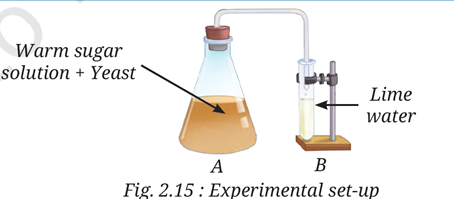
i) What would happen if yeast was not added in Flask A?
Answer: The sugar solution in Flask A undergoes fermentation due to the action of yeast. It breaks down sugar into alcohol and CO2.
ii) What do you observe in Test Tube B after 4 hours? What do you think?
Answer: We observe that in Test Tube B, the lime water turns milky or cloudy. This happens because of the CO2 gas produced during fermentation in Flask A. When CO2 reacts with lime water, it forms an insoluble precipitate (PPT) of calcium carbonate, which makes the water appear milky.
iii) What would happen if yeast was not added in Flask A?
Answer: If yeast was not added, fermentation would not occur. There would be no formation of CO2 and alcohol. Both the sugar solution and the lime water would remain unchanged.
Que :- Differentiate between a plant cell and an animal cell:
| Animal Cell | Plant Cell |
| 1) Animal cells have a random nucleus. | 1) Plant cells have a permanent nucleus. |
| 2) They have only a cell membrane. | 2) They consist of both a cell wall and a cell membrane. |
| 3) They contain only cytoplasm. | 3) They contain chloroplasts (chlorophyll) and cytoplasm. |
| 4) They have many tiny food vacuoles. | 4) They have one large food vacuole. |