
Notes Textbook Solution and Videos
1. Choose the correct option.
i) In an ideal gas, the molecules possess
(A) only kinetic energy
(B) both kinetic energy and potential energy
(C) only potential energy
(D) neither kinetic energy nor potential energy
Answer:_ A) Only Kinetic Energy
Explanation:- Since Intermolecular force of attraction is absent in Ideal gas, It does not have Potential energy . Therefore whatever energy we provide to ideal gas is stored in the form of Kinetic Energy
ii) The mean free path λ of molecules is given by
$$1) sqrt{frac{2}{πnd^2}}$$
$$2) frac{1}{πnd^2}$$
$$3)frac{1}{sqrt{2}πind^2}$$
$$4)frac{1}{sqrt{2πnd^2}}$$
where n is the number of molecules per unit volume and d is the diameter of the molecules.
Solution $$frac{1}{sqrt{2}πind^2}$$
iii) If pressure of an ideal gas is decreased by 10% isothermally, then its volume will
(A) decrease by 9%
(B) increase by 9%
(C) decrease by 10%
(D) increase by 11.11%
Solution:-
increase by 11.11%
Explanation:-
According to Boyle’s Law, for an ideal gas at constant temperature, the pressure and volume are inversely proportional to each other. Mathematically,
P1V1 = P2V2, where P1 and V1 are the initial pressure and volume, and P2 and V2 are the final pressure and volume.
In this case, the temperature is kept constant (isothermal process), and the pressure is decreased by 10%. Let the final pressure be P2 = 0.9P1.
Using Boyle’s Law, we can find the final volume V2:
P1V1 = P2V2 V2 = V1(P1/P2) V2 = V1(P1/0.9P1) V2 = V1/0.9 V2 = (10/9)V1
Therefore, the final volume V2 is (10/9) times the initial volume V1.
Comparing V2 to V1, we can calculate the percentage change in volume:
% change = ((V2 – V1)/V1) x 100% % change = (((10/9)V1 – V1)/V1) x 100% % change = (1/9) x 100% % change = 11.11%
Therefore, the answer is (D) increase by 11.11%.
iv) If a = 0.72 and r = 0.24, then the value of tr is
(A) 0.02 (B) 0.04 (C) 0.4 (D) 0.2
Answer:_ B) 0.04
Explanation:_
We can use the relation between the coefficients of absorption, reflection, and transmission given by:
a + r + t = 1
where t is the coefficient of transmission. Substituting the values given in the problem, we get:
0.72 + 0.24 + t = 1
Solving for t, we get:
t = 1 – 0.72 – 0.24 = 0.04
Therefore, the value of tr (transmittance) is 0.04.
So, the correct answer is (B) 0.04.
v) The ratio of emissive power of a perfect blackbody at 1327o C and 527o C is
(A) 4:1 (B) 16 : 1 (C) 2 : 1 (D) 8 : 1
Answer:_ 16:1
Explanation:_
The emissive power of a perfect blackbody is given by the Stefan-Boltzmann law as:
P = σT^4
where P is the power emitted per unit surface area, T is the temperature of the blackbody, and σ is the Stefan-Boltzmann constant.
Let the emissive powers at temperatures 1327°C and 527°C be P1 and P2, respectively. Then we have:
P1/P2 = (σT1^4)/(σT2^4) = (T1/T2)^4
where we have cancelled out the Stefan-Boltzmann constant from the numerator and denominator.
Substituting T1 = 1327 + 273 = 1600 K and T2 = 527 + 273 = 800 K, we get:
P1/P2 = (1600/800)^4 = 2^4 = 16
Therefore, the ratio of emissive power of the perfect blackbody at 1327°C and 527°C is 16:1.
Hence, the correct answer is option (B) 16 : 1.
2. Answer in brief.
i) What will happen to the mean square speed of the molecules of a gas if the temperature of the gas increases?
Answer:_
If the temperature of a gas increases, the mean square speed of the molecules of the gas will increase in the same proportion.
Explanation:-
According to the kinetic theory of gases, the mean square speed of the molecules of a gas is directly proportional to the temperature of the gas.
Mathematically, we can write:
v^2 ∝ T
where v is the mean square speed of the gas molecules and T is the absolute temperature of the gas.
Therefore, if the temperature of the gas increases, the mean square speed of the gas molecules will also increase, and vice versa.
This relationship can be understood intuitively by considering that as the temperature of the gas increases, the kinetic energy of the gas molecules also increases. Since the mean square speed is a measure of the average kinetic energy of the gas molecules, it will increase with the temperature of the gas.
ii) On what factors do the degrees of freedom depend?
Answer:_ the degrees of freedom refer to the number of independent directions in which the gas molecules can move and store energy.
It is depend on following factors.
(i) the number of atoms forming a molecule
(ii) the structure of the molecule
(iii) the temperature of the gas.
iii) Write ideal gas equation for a mass of 7 g of nitrogen gas.
Answer:_
The ideal gas equation is given as:
PV = nRT
where P is the pressure of the gas, V is its volume, n is the number of moles of the gas, R is the universal gas constant, and T is the absolute temperature of the gas.
To find the ideal gas equation for a mass of 7 g of nitrogen gas, we need to first determine the number of moles of nitrogen gas. We can use the molar mass of nitrogen gas to convert the mass to moles:
Molar mass of nitrogen gas (N2) = 28 g/mol
Number of moles of N2 = Mass of N2 / Molar mass of N2 = 7 g / 28 g/mol = 0.25 mol
Now we can substitute the values in the ideal gas equation:
PV = nRT
P(V) = (0.25 mol) (R) (T)
PV = (0.25 mol)(8.314 J/mol-K)(T) (using R = 8.314 J/mol-K)
PV = 2.0785 T
where P is the pressure of the nitrogen gas and V is its volume, and T is the absolute temperature in Kelvin.
iv) What is an ideal gas ? Does an ideal gas exist in practice ?.
Answer;-
A gas obeying ideal gas equation at all pressures and temperatures is an ideal gas.
An ideal gas is a theoretical gas composed of molecules that are point masses, have no volume, and do not interact with each other except through perfectly elastic collisions. An ideal gas is purely hypothetical and such gases do not exist in reality.
v) Define athermanous substances and diathermanous substances.
Answer:-
Substances which are largely opaque to thermal radiations i.e., do not transmit heat radiations incident on them, are known as athermanous substances.
Examples of athermanous substances are water, wood, iron, copper, moist air, benzene etc.
A substance through which heat radiations can pass is known as a diathermanous substance. For a diathermanous body, tr 0. A
diathermanous body is neither a good absorber nor a good reflector.
Examples of diathermanous substances are glass, quartz, sodium chloride, hydrogen, oxygen, dry air etc.
3. When a gas is heated its temperature increases. Explain this phenomenon based on kinetic theory of gases
Answer:_
The kinetic theory of gases explains that the temperature of a gas is related to the average kinetic energy of its molecules. When a gas is heated, its temperature increases because the heat energy is transferred to the gas molecules, causing them to move faster on average. This increase in kinetic energy of the molecules leads to an increase in the velocity of the molecules, which in turn leads to an increase in the temperature of the gas.
Specifically, the kinetic theory of gases assumes that gas molecules are in constant random motion and that their kinetic energy is proportional to their temperature. The molecules in a gas move in straight lines until they collide with another molecule or with the walls of the container. When a gas is heated, the molecules absorb the heat energy and move faster, which means that they collide with each other and the walls of the container more frequently and with more force. This results in an increase in the pressure and temperature of the gas.
In summary, when a gas is heated, the average kinetic energy of its molecules increases, which leads to an increase in the velocity and frequency of the molecular collisions, resulting in an increase in the temperature of the gas.
4. Explain, on the basis of kinetic theory, how the pressure of gas changes if its volume is reduced at constant temperature.
Answer:-
- A gas’s average kinetic energy per molecule remains constant at a constant temperature.
- If a gas’s volume is decreased at a constant temperature, the number of gas molecules colliding with the container’s walls per unit time increases.
- This results in an increase in the momentum transferred per unit time per unit area, which is the force exerted by the gas on the walls.
- Consequently, the gas pressure increases.
5. Mention the conditions under which a real gas obeys ideal gas equation.
Answer:-
Low density, low pressure or high temperature. In other words, a condition where gas molecules are far apart so that molecular interactions are negligible.
6. State the law of equipartition of energy and hence calculate molar specific heat of mono- and di-atomic gases at constant volume and constant pressure.
Answer:-
The law of equipartition of energy states that at thermal equilibrium, the total energy of a molecule is distributed equally among all its degrees of freedom. For a gas molecule, the degrees of freedom include its translational, rotational, and vibrational energy.
According to this law, each degree of freedom contributes (1/2) kT to the total energy of the molecule, where k is the Boltzmann constant and T is the absolute temperature.
Using this law, we can calculate the molar specific heat of a monoatomic gas at constant volume and constant pressure as follows:
- For constant volume (Cv):
- The gas molecule has three translational degrees of freedom.
- Therefore, the energy contribution per molecule is (3/2) kT.
- The molar specific heat at constant volume is given by Cv = (3/2) R, where R is the gas constant.
- For constant pressure (Cp):
- The gas molecule also has two rotational degrees of freedom.
- Therefore, the energy contribution per molecule is (5/2) kT.
- The molar specific heat at constant pressure is given by Cp = (5/2) R.
For a diatomic gas, the calculation is slightly different because it has additional vibrational degrees of freedom. Therefore, we have:
- For constant volume (Cv):
- The gas molecule has three translational degrees of freedom.
- It also has two rotational degrees of freedom.
- Therefore, the energy contribution per molecule is (5/2) kT.
- The molar specific heat at constant volume is given by Cv = (5/2) R.
- For constant pressure (Cp):
- The gas molecule also has one vibrational degree of freedom in addition to the translational and rotational degrees of freedom.
- Therefore, the energy contribution per molecule is (7/2) kT.
- The molar specific heat at constant pressure is given by Cp = (7/2) R.
Note that these calculations assume that the gas is ideal and that the degrees of freedom are independent. In reality, some of these assumptions may not hold for certain gases or conditions, and the molar specific heat may deviate from the values calculated above.
7. What is a perfect blackbody ? How can it be realized in practice?
Answer:-
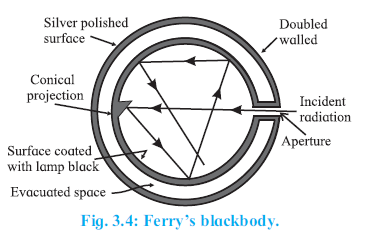
A body, which absorbs the entire radiant energy incident on it, is called an ideal or perfect blackbody.
Ferry’s blackbody:-
Ferry’s blackbody is made up of a hollow sphere with two walls, and a tiny hole or aperture that allows radiant heat to enter. The space between the walls is empty and the outer surface of the sphere is covered in silver. The inner surface is coated in lampblack, and there’s a conical projection opposite the aperture to prevent reflection. This design ensures that radiation entering through the hole is almost entirely absorbed, and has a negligible chance of escaping back through the aperture. It’s essentially a perfect blackbody. Similarly, a cavity radiator, made from a block of material with an internal cavity connected to the outside world by a small hole, can also act as a blackbody. When heated to a high temperature, it emits thermal radiation which is identical to that emitted by a perfect blackbody. In both cases, the shape and size of the cavity or block don’t matter – it’s the temperature of the walls that determines the emitted radiation. In the same way that we use an ideal gas to simplify calculations in the kinetic theory of gases, working with an ideal blackbody is also useful.
8. State (i) Stefan-Boltmann law and (ii) Wein’s displacement law.
Answer:-
- Stefan-Boltmann law
The rate of emission of radiant energy per unit area or the power radiated per unit area of a perfect blackbody is directly proportional to the fourth power of its absolute temperature
The law can be expressed mathematically as:
P = σA T4
where P is the total power radiated per unit surface area, σ is the Stefan-Boltzmann constant (5.67 x 10^-8 W/m2K4), A is the surface area of the blackbody, and T is its absolute temperature.
2) Wein’s displacement law.
The law states that the wavelength of maximum emission (or peak wavelength) is inversely proportional to the absolute temperature of the blackbody. This law is expressed mathematically as:
λ_max = b/T
where λ_max is the wavelength of maximum emission, T is the absolute temperature of the blackbody, and b is Wien’s constant, which has a value of 2.897 x 10^-3 m K.
9. Explain spectral distribution of blackbody radiation
Answer:-
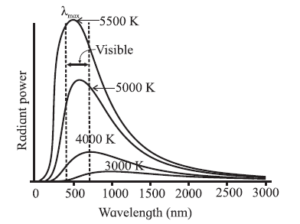
From experimental curves, it is observed that 1. at a given temperature, the energy is not uniformly distributed in the spectrum (i.e., as a function of wavelength) of blackbody,
2. at a given temperature, the radiant power emitted initially increases with increase of wavelength, reaches it’s maximum and then decreases. The wavelength corresponding to the radiation of maximum intensity, λmax , is characteristic of the temperature of the radiating body. (Remember, it is not the maximum wavelength emitted by the object),
3. area under the curve represents total energy emitted per unit time per unit area by the blackbody at all wavelengths,
4. the peak of the curves shifts towards the left – shorter wavelengths, i.e., the value of λmax decreases with increase in temperature,
5. at higher temperatures, the radiant power or total energy emitted per unit time per unit area (i.e., the area under the curve). corresponding to all the wavelengths increases,
6. at a temperature of 300 K (around room temperature), the most intense of these waves has a wavelength of about 5 × 10⁻⁵ m; the radiant power is smaller for wavelengths other than this value. Practically all the radiant energy at this temperature is carried by waves longer
than those corresponding to red light. These are infrared radiations.
10. State and prove Kirchoff’s law of heat radiation.
Answer:-
It states that at a given temperature, the ratio of emissive power to coefficient of absorption of a body is equal to the emissive power of a perfect blackbody at the same temperature for all wavelengths.
Let R be the emissive power of body A, RB be the emissive power of blackbody B and a be the coefficient of absorption of body A. If Q is the quantity of radiant heat incident on each body in unit time and Qa is the quantity of radiant heat absorbed by the body A, then Qa = a Q. As the temperatures of the body A and blackbody B remain the same, both must emit the same amount as they absorb in unit time. Since emissive power is the quantity of heat radiated from unit area in unit time, we can write Quantity of radiant heat It states that at a given temperature, the ratio of emissive power to coefficient of absorption of a body is equal to the emissive power of a perfect blackbody at the same temperature for all wavelengths.
Let R be the emissive power of body A, RB be the emissive power of blackbody B and a be the coefficient of absorption of body A. If Q is the quantity of radiant heat incident on each body in unit time and Qa is the quantity of radiant heat absorbed by the body A, then Qa = a Q. As the temperatures of the body A and blackbody B remain the same, both must emit the same amount as they absorb in unit time. Since emissive power is the quantity of heat radiated from unit area in unit time, we can write Quantity of radiant heat absorbed by body A= Quantity of heat emitted by body A
absorbed by body A= Quantity of heat emitted by body A
a Q = R — (3.42)
For the perfect blackbody B,
Q = RB — (3.43)
Dividing Eq. (3.42) by Eq.(3.43), we get
A = R /RB
or, R =a / RB — (3.44)
But R /RB =e
a = e.
11. Calculate the ratio of mean square speeds of molecules of a gas at 30 K and 120 K.
Answer:-
Data: $$T_1 = 30text{ K}$$, $$T_2 = 120text{ K}$$
The mean square speed, $$bar{v}^2 = dfrac{3RT}{M_0}$$
Therefore, $$bar{v}_1^2/bar{v}_2^2 = T_1/T_2$$ for a given gas
Hence, $$bar{v}_1^2/bar{v}_2^2 = (30text{ K})/(120text{ K}) = 1/4$$
This is the required ratio.
12 Two vessels A and B are filled with same gas where volume, temperature and pressure in vessel A is twice the volume, temperature and pressure in vessel B. Calculate the ratio of number of molecules of gas in vessel A to that in vessel B.
Data: VA = 2VB, TA = 2TB, PA = 2PB PV = NkBT
∴ The number of molecules, N = PV/(kBT)
∴ NA = (PAVA)/(kBTA) and NB = (PBVB)/(kBTB)
∴ NA/NB = (PA/PB)(VA/VB)(TB/TA) = (2)(2)(1/2) = 2
This is the required ratio.
https://youtu.be/8HGAOPWakxQ
13. 13. A gas in a cylinder is at pressure P. If the masses of all the molecules are made one third of their original value and their speeds are doubled, then find the resultant pressure.
p>m2 = m1/3, vrms2 = 2vrms1 as the speeds of all molecules are doubled
Pressure, P = 1/3.mN/V.v2rms
∴ P1 = 1/3,(m1N)/V.vrms 12 and
∴ P2 = 1/3,(m2N)/V.vrms 22
∴ P2/P1 = (m2/m1)((vrms22)/(vrms 12))
=(m2/m1)((vrms 2)/(vrms 1)) 2
= ((m1//3)/m1)(2) 2 = 4/3
∴ P2 = 4/3P1 = 4/3P
This is the resultant pressure.
https://youtu.be/I8h6-_ZAa18https://youtu.be/PS7hTYKxO_Mhttps://youtu.be/XupAulqqHEo
https://youtu.be/tlhwbsT-3wohttps://youtu.be/HiIBdnZYmXwhttps://youtu.be/JXKjkDVSK3Ihttps://youtu.be/9FlTr8rnF4Yhttps://youtu.be/ULv0aRXtl4Ehttps://youtu.be/MFjHvApCheAhttps://youtu.be/GfMN3cuZNhY