
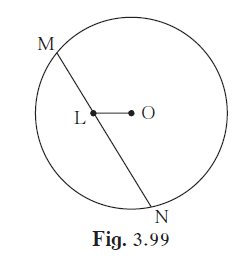
In the given figure, seg MN is a chord of a circle with centre O. MN = 25, L is a point on chord MN such that ML = 9 and d(O,L) = 5. Find the radius of the circle.
Chapter 3 – Circle – Text Book Solution
Problem Set 3 | Q 21 | Page 89
In the given figure, seg MN is a chord of a circle with centre O. MN = 25, L is a point on chord MN such that ML = 9 and d(O,L) = 5. Find the radius of the circle.
solution
seg MN is a chord of a circle with centre O.
Draw OP ⊥ MN and join OM.
MP = PN = `(MN)/2 = 25/2`units (Perpendicular drawn from the centre of a circle on its chord bisects the chord)
∴ LP = MP − ML = `25/2-9=7/2`units
In right ∆OPL,
[{OL}^2 = {LP}^2 + {OP}^2 ]
[ Rightarrow OP = sqrt{{OL}^2 – {LP}^2}]
[ Rightarrow OP = sqrt{5^2 – left( frac{7}{2} right)^2}]
[ Rightarrow OP = sqrt{25 – frac{49}{4}}]
[ Rightarrow OP = sqrt{frac{51}{4}} = frac{1}{2}sqrt{51} ] units
In right ∆OPM,
[{OM}^2 = {MP}^2 + {OP}^2 ]
[ Rightarrow OM = sqrt{left( frac{25}{2} right)^2 + left( frac{sqrt{51}}{2} right)^2}]
[ Rightarrow OM = sqrt{frac{625 + 51}{4}}]
[ Rightarrow OM = sqrt{frac{676}{4}}]
[ Rightarrow OM = sqrt{169} = 13 ] units
Thus, the radius of the circle is 13 units.
Explanation:-
Consider a circle with center O and a chord MN. Let OP be perpendicular to MN and OM be another line joining O to M. We need to find the radius of the circle.
By the perpendicular bisector theorem, OP is the perpendicular bisector of MN. Therefore, MP = PN = (MN)/2 = 25/2 units.
We also have ML = 9 units. Thus, LP = MP – ML = 25/2 – 9 = 7/2 units.
Using Pythagoras theorem in right triangle OLP, we get:
${OL}^2 = {LP}^2 + {OP}^2$
Solving for OP, we get:
$OP = sqrt{{OL}^2 – {LP}^2}$
Substituting the values, we get:
$OP = sqrt{5^2 – left( frac{7}{2} right)^2} = sqrt{25 – frac{49}{4}} = sqrt{frac{51}{4}} = frac{1}{2}sqrt{51}$ units.
Next, using Pythagoras theorem in right triangle OPM, we get:
${OM}^2 = {MP}^2 + {OP}^2$
Substituting the values, we get:
$OM = sqrt{left( frac{25}{2} right)^2 + left( frac{sqrt{51}}{2} right)^2} = sqrt{frac{625 + 51}{4}} = sqrt{frac{676}{4}} = sqrt{169} = 13$ units.
Therefore, the radius of the circle is 13 units.
Chapter 3 – Circle – Text Book Solution
Problem Set 3 | Q 21 | Page 89
Click Here to see All the Textbook solution of Circle