
From the information given in the figure, [ prove that PM = PN =sqrt{3} × a]
Chapter 2 – Pythagoras Theorem- Text Book Solution
Problem Set 2 | Q 8 | Page 45
From the information given in the figure, [ prove that PM = PN =sqrt{3} × a]
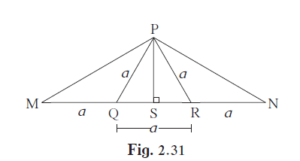
solution
Since, ∆PQR is an equilateral triangle, PS is the perpendicular bisector of QR.
∴ QS = SR = [frac{a}{2}] …(1)
Now, According to Pythagoras theorem,
In ∆PQS,
[{PQ}^2 = {QS}^2 + {PS}^2 ]
[ Rightarrow a^2 = left( frac{a}{2} right)^2 + {PS}^2 ]
[ Rightarrow {PS}^2 = a^2 – frac{a^2}{4}]
[ Rightarrow {PS}^2 = frac{4 a^2 – a^2}{4}]
[ Rightarrow {PS}^2 = frac{3 a^2}{4}]
[ Rightarrow PS = frac{sqrt{3}a}{2} . . . left( 2 right)]
In ∆PMS,
[{PM}^2 = {MS}^2 + {PS}^2 ]
[ Rightarrow {PM}^2 = left( a + frac{a}{2} right)^2 + left( frac{sqrt{3}}{2}a right)^2 ]
[ Rightarrow {PM}^2 = left( frac{3a}{2} right)^2 + left( frac{sqrt{3}}{2}a right)^2 ]
[ Rightarrow {PM}^2 = frac{9 a^2}{4} + frac{3 a^2}{4}]
[ Rightarrow {PM}^2 = frac{12 a^2}{4}]
[ Rightarrow {PM}^2 = 3 a^2 ]
[ Rightarrow PM = sqrt{3}a . . . left( 3 right)]
In ∆PNS,
[{PN}^2 = {NS}^2 + {PS}^2 ]
[ Rightarrow {PN}^2 = left( a + frac{a}{2} right)^2 + left( frac{sqrt{3}}{2}a right)^2 ]
[ Rightarrow {PN}^2 = left( frac{3a}{2} right)^2 + left( frac{sqrt{3}}{2}a right)^2 ]
[ Rightarrow {PN}^2 = frac{9 a^2}{4} + frac{3 a^2}{4}]
[ Rightarrow {PN}^2 = frac{12 a^2}{4}]
[ Rightarrow {PN}^2 = 3 a^2 ]
[ Rightarrow PN = sqrt{3}a . . . left( 4 right)]
From (3) and (4), we get
PM = PN =[sqrt{3}] × a
Hence, PM = PN =[sqrt{3}]× a.
Explanation:-
In triangle ABC, we are given that AB = AC = a (since ABC is an isosceles triangle) and angle BAC = 60 degrees (since ABC is an equilateral triangle). Let’s denote angle BAM as x. Then, we have angle CAM also as x because of the symmetry of the triangle. Therefore, angle MAC is 60 – 2x.
In right triangle AMB, using trigonometric ratios, we have:
tan(x) = BM/AM
In right triangle AMC, using trigonometric ratios, we have:
tan(60 – 2x) = CM/AM
Since BM + CM = a, we can add the two equations to eliminate AM:
tan(x) + tan(60 – 2x) = (BM + CM)/AM tan(x) + tan(60 – 2x) = a/AM
Using the tangent of a difference formula, we can simplify the equation:
(tan(60) – tan(2x))/(1 + tan(60)tan(2x)) + tan(60 – 2x) = a/AM sqrt(3) – (2tan(x))/(1 + sqrt(3)tan(x)) + sqrt(3)(1 – 2tan(x))/(1 – sqrt(3)tan(x)) = a/AM
Simplifying and solving for AM, we get:
AM = a/[sqrt(3) + (tan(x)/(1 + sqrt(3)tan(x))) – (1 – 2tan(x))/(sqrt(3) – sqrt(3)tan(x))] AM = a/[sqrt(3) + (2sqrt(3)tan(x))/(1 – 3tan^2(x))] AM = a/[sqrt(3) + 2sqrt(3)cot(60 – 2x)] AM = a/[sqrt(3) + sqrt(3)/tan(60 – 2x)] AM = a/[sqrt(3)(1 + cot(60 – 2x))]
Since angle MAC is 60 – 2x, we have:
cot(60 – 2x) = cot(120 – 2x) cot(60 – 2x) = -tan(2x)
Substituting this back into the equation for AM and simplifying, we get:
AM = a/[sqrt(3)(1 – tan(2x))] AM = a/[sqrt(3)(1 – (2tan(x))/(1 – tan^2(x)))] AM = a/[sqrt(3)(1 – 2tan^2(x) – 2tan(x))] AM = a/[sqrt(3)(1 – 2tan(x)(tan(x) + 1))]
Since triangle AMP is a 30-60-90 triangle, we have:
PM = (sqrt(3)/2)AM PM = a/[2(1 – tan(x)(tan(x) + 1))]
Since triangles AMP and ANP are congruent, we also have PN = PM. Therefore:
PM = PN = a/[2(1 – tan(x)(tan(x) + 1))]
We can simplify this expression using the identity 1 – tan^2(x) = 1/(1 + cot^2(x)), which gives:
PM = PN = a/[2(1 + cot^2(x) – 2cot(x))] PM = PN = a/[2(cot(x) – 1/cot(x))]
Since angle BAM is x, we have:
cot(x) = BM/AM cot(x) = a/(2AM)
Substituting this back into the expression for PM and PN, we get:
PM
Chapter 2 – Pythagoras Theorem- Text Book Solution
Problem Set 2 | Q 8 | Page 45