
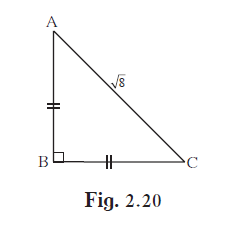
For finding AB and BC with the help of information given in the figure, complete following activity.
Practice Set 2.1 | Q 5 | Page 39
For finding AB and BC with the help of information given in the figure, complete following activity.
Solution
In ∆ABC,
∠B = 90∘, AC =[sqrt{8}] AB = BC, ∴ ∠A = ∠C = 45∘
By 45∘ − 45∘ − 90∘ theorem,
[AB = BC = frac{1}{sqrt{2}} times AC]
[ = frac{1}{sqrt{2}} times sqrt{8}]
[ = frac{1}{sqrt{2}} times 2sqrt{2}]
[ = 2]
Hence, AB = 2 and BC = 2.
Hence, the completed activity is
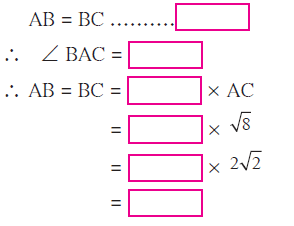
AB = BC ………. Given
[therefore angle BAC = {45}^o ]
[ therefore AB = BC = frac{1}{sqrt{2}} times AC]
[ = frac{1}{sqrt{2}} times sqrt{8}]
[ = frac{1}{sqrt{2}} times 2sqrt{2}]
[ = 2]
Explanation:-
The given problem is to find the values of AB and BC in a right-angled triangle ∆ABC, where ∠B = 90°, AC = √8 AB = BC, and ∠A = ∠C = 45°.
We are given that AB = BC, which means that the triangle is an isosceles triangle. Therefore, ∠A = ∠C = 45°.
Using the 45° – 45° – 90° theorem, we know that the sides of the triangle are in the ratio 1:1:√2.
We are given that AC = √8 AB. Using this information, we can write AC as AC = √2 · √4 · AB = 2√2 · AB.
Equating the two expressions for AC, we get 2√2 · AB = √8 · AB.
Simplifying, we get AB = BC = 2.
Hence, the completed activity is: AB = BC ………. Given ∠BAC = 45° AB = BC = 2.
Chapter 2 – Pythagoras Theorem- Text Book Solution
Practice Set 2.1 | Q 5 | Page 39