
Class 7 Curiosity
Taken from the notebook of Mr. Reaansh Polojwar
Questions and Answers
Que :- Draw a label diagram to show general label diagram of plant cell and animal cell.
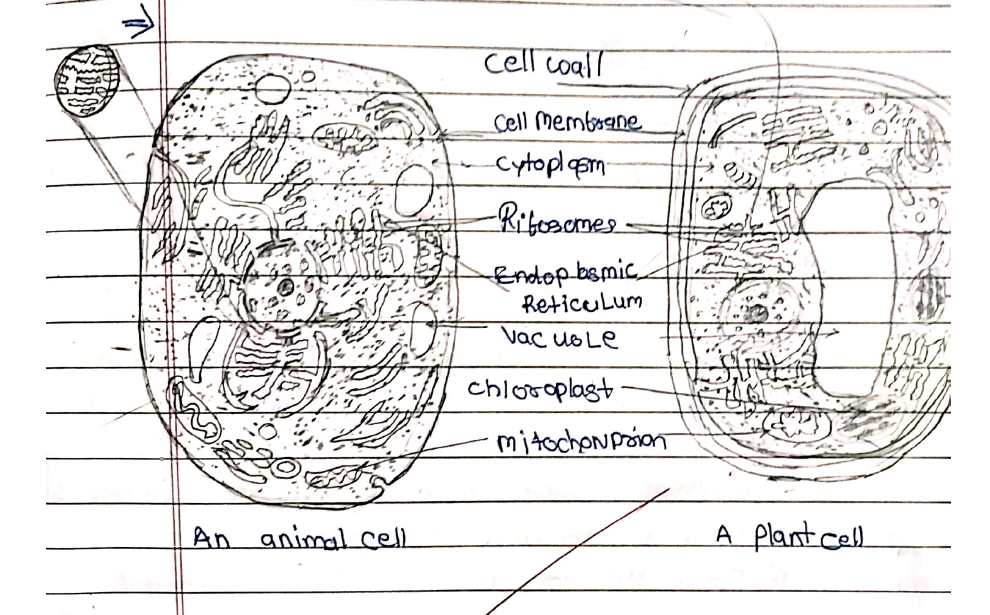
Short Answer Questions (Type I):
1) What are the building blocks of life? Why are they so called?
Answer:- i) All living things are made up of one or more cells. ii) Cells are, therefore, known as the building blocks of life.
2) What is a semi-permeable membrane? Where will you find it in a cell?
Answer:- i) It allows water, minerals, and certain essential substances to pass through. ii) It is therefore called a semi-permeable membrane. iii) The cell membrane is the thin layer that surrounds the cell.
3) What is the importance of genes?
Answer:- i) Within the nucleus are thread-like structures called chromosomes. ii) These carry genes which hold the instructions the cell needs to function and to make new cells. iii) Genes are responsible for inheritance, that is, passing traits from parents to their offspring.
4) Name an organelle present in a plant cell but not in an animal cell and state its importance.
Answer:- a) i) Plastids are organelles found only in plant cells. ii) They are of different types and colours.
b) Chloroplast: It is an important plastid containing the green pigment chlorophyll. It gives leaves their green colour and is essential for photosynthesis.
c) Chromoplast: It gives yellow/red colour to flowers and fruits.
d) Leucoplasts: It is colourless and it stores food.
6) What is the function of the nucleus?
Answer:- Function of nucleus:
i) It is the control centre of the cell.
ii) It directs the growth of the cell and controls all its activities.
iii) It can, therefore, be called the brain of the cell.
D. Short Answer Questions (Type II)
2) Differentiate between unicellular and multicellular organisms, with two examples of each.
| Unicellular Organisms | Multicellular Organisms |
| i) Organisms made up of only one cell are known as unicellular organisms. | i) Organisms made up of many cells are known as multicellular organisms. |
| ii) They are too small to be seen by the naked eye. | ii) They are larger, and a greater number of cells make up their body. |
| iii) Ex: Bacteria, yeast, Amoeba. | iii) Ex: Humans, birds, insects, and trees. |
2) What is the cell membrane? What are its functions? i) The cell membrane (also called the plasma membrane) is the thin layer that surrounds the cell. ii) It allows water, minerals, and certain essential substances to pass through.
4) State the function of vacuoles in a plant cell. i) In plant cells, vacuoles play an important role. ii) They store substances, remove waste, and help maintain the shape of the cell, thus providing strength and support to the plant.
E. Long Answer Questions
1) Who proposed the cell theory of life? What are the main points of the theory?
In 1838, two German biologists, Matthias Schleiden and Theodor Schwann, put forward the cell theory of life. The main points of this theory are as follows:
i) All living things are made up of cells.
ii) The cell is the basic unit of life.
iii) All cells are similar in their basic structure and function but are not identical; they differ in size and shape.
iv) New cells are formed when existing cells divide.
v) The way cells are organized in the body of a living organism determines its overall structure.
2) What are organelles? Name two important organelles and state their functions.
Organelles are various types of structures in the cytoplasm that carry out the different functions of the cell.
Mitochondria :
i) Mitochondria are small rod-like structures.
ii) They break down food to provide energy for the cell’s activities.
iii) For this reason, they are called the powerhouses of the cell.
Vacuoles:
i) Vacuoles are sac-like structures.
ii) Plant cells usually have one or more large vacuoles, while animal cells have smaller or no vacuoles.
iii) Vacuoles store important substances, remove waste, and help maintain the shape of the cell, thus providing strength and support to the plant.
3) What are the differences between plant and animal cells?
| Plant Cell | Animal Cell |
| i) A plant cell is larger than an animal cell. | i) An animal cell is smaller than a plant cell. |
| ii) It is surrounded by a cell wall in addition to the cell membrane. | ii) Vacuoles are either absent or very small. |
| iii) It usually has one or two large vacuoles. | iii) Vacuoles are either absent or very small. (Note: This point seems to have been accidentally written twice in your notes) |
| iv) It has different kinds of plastids. | iv) It does not have plastids. |
4) Why are cells of different shapes and sizes? Name three types of cells and state how the shape and size of each help in performing their functions.
Each type of cell performs a specific function in the body. These structures are specially adapted to do that job efficiently.
i) Different functions require different designs.
ii) Shape helps the cell perform its role better.
iii) Size depends on the work that it has to do.
Three types of cells and their shape, size, and functions:
i) RBC (Red Blood Cells)
- Shape: Biconcave disc
- Size: Small
- Function:
- i) The shape increases the surface area to carry more oxygen.
- ii) Its small size helps it move easily through narrow blood vessels.
ii) Nerve Cell (Neuron)
- Shape: Long and branched
- Size: Very long
- Function:
- i) The long structure helps in transmitting messages over a long distance.
- ii) Being branched helps it connect with other cells.
iii) Muscle Cell
- Shape: Long, spindle, or cylindrical
- Size: Large
- Function:
- i) The long shape helps in contraction and relaxation.
- ii) It helps in the movement of body parts.
5) (a) What is cell division? Why is cell division necessary? (b) Describe the process of cell division with the help of a diagram.
a) Cell Division: The process of a cell splitting into daughter cells is known as cell division. Cell division is necessary for growth, development, repairing of damaged tissue, reproduction, and maintaining size and efficiency.
b) Stages of cell division (mitosis) are as follows:
i) Prophase: Chromosomes become visible inside the cell.
ii) Metaphase: Chromosomes arrange in the middle of the cell.
iii) Anaphase: Chromosomes move to opposite sides.
iv) Telophase: Two new nuclei are formed.
v) Cytokinesis: The cell splits into two daughter cells.