
Natural Domain Class 7
Geography Textbook
Chapter 1 Our Environment
1. Tick [✓] the correct option.
a. Which of these is the outermost solid layer of the earth?
i. lithosphere
ii. hydrosphere
iii. atmosphere
iv. biosphere
Answer: i. lithosphere
b. Which of these is not a part of the natural ecosystem?
i. forest
ii. desert
iii. grasslands
iv. aquarium
Answer: iv. aquarium
c. Which of the following does not fall under natural environment?
i. mountain
ii. ocean
iii. sea
iv. road
Answer: iv. road
2. In the question given below, there are two statements marked as Assertion (A) and Reason (R). Read the statements and choose the correct option:
a. Assertion (A): Nitrogen is an important gas present in the atmosphere.
Reason (R): Nitrogen is required to maintain the fertility of the soil.
- Both A and R are true, and R is the correct explanation of A.
- Both A and R are true, but R is not the correct explanation of A.
- iii. A is true, but R is false.
iv. A is false, but R is true.
Answer: i. Both A and R are true, and R is the correct explanation of A.
b. Assertion (A): All organisms grow in their unique environment to which they have adapted.
Reason (R): All organisms are largely influenced by their physical environment.
- Both A and R are true, and R is the correct explanation of A.
- Both A and R are true, but R is not the correct explanation of A.
- A is true, but R is false.
- A is false, but R is true.
Answer: i. Both A and R are true, and R is the correct explanation of A.
Q: What do you understand by environmental degradation?
Answer: Environmental degradation refers to the loss of biodiversity, and the depletion and degradation of natural resources due to pollution, overexploitation, and obliteration.
Q: Name the four realms of Earth.
Answer: The four realms of the Earth are the lithosphere, hydrosphere, atmosphere, and biosphere.
Q: State the importance of the hydrosphere as one of the domains of the Earth.
Answer:
- Water supports all forms of life.
- Oceans are a source of food and minerals.
- Oceans facilitate trade and transportation.
- Oceans help in moderating the climate of coastal regions.
- As humans, we use freshwater for different domestic, agricultural, and industrial uses.
Q: What is the natural environment?
Answer: The natural environment includes all living and non-living things occurring naturally on Earth.
Q: Why is the atmosphere an important domain of the Earth?
Answer: The various gases present in the atmosphere are useful to us in many ways, such as:
- Nitrogen is required to maintain the fertility of the soil.
- Oxygen is essential for sustaining all forms of life on Earth.
- Carbon dioxide is essential for plants.
- Ozone, present in the atmosphere, protects us from the harmful ultraviolet radiation of the Sun.
Q: Briefly explain what the lithosphere is and why it is important.
Answer: “Lithos” means stone; it is the outer solid crust—the outermost solid layer of the Earth. It is composed of rocks and minerals and covered by a thin layer of soil. It is important because it provides land for agricultural settlements and human habitation, as well as forests, minerals, and power.
Q: Briefly describe the abiotic components of the natural environment.
Answer: Abiotic components are the non-living parts of the natural environment. They include the lithosphere, hydrosphere, and atmosphere. These components provide land, water, air, sunlight, and minerals that are essential for the survival and growth of living organisms. They also help maintain the balance of nature and support all forms of life. They also influence climate, weather, and natural processes on Earth.
Q: What are the causes of environmental degradation?
Answer: Environmental degradation refers to the loss of biodiversity and the depletion and degradation of natural resources due to pollution, overexploitation, and obliteration. Rapid and unplanned urban development leads to the deterioration of air and water quality and the generation of wastes. Increasing transport networks also have a negative impact on the environment. For instance, the construction of ports and harbors disrupts the sensitive ecosystem of coastal areas.
Q: Give reason: Abiotic components are important for biotic components.
Answer: They provide air, water, sunlight, and minerals needed for life. They help plants prepare food and support their growth. They provide suitable conditions for the survival of all living organisms.
Q: Give reason: Oceans are also important to us.
Answer: Oceans are a source of food and minerals. They facilitate trade, transport, agriculture, and industries. They help to regulate the climate and support aquaculture and industries.
Q: Give reason: Organisms live in a community.
Answer: Organisms depend on one another for food and shelter. They interact with each other and with the physical environment as part of an ecosystem. Living in a community helps maintain ecological balance and supports survival.
Q: Picture Study
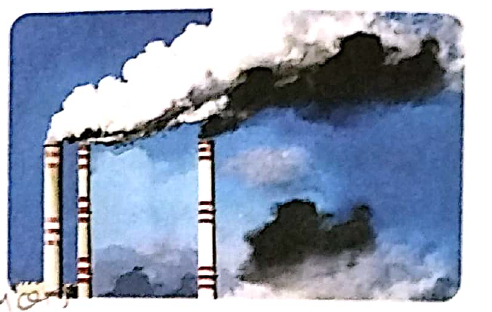
(a): Is it a natural environment or a human-made environment? Why?
Answer: It is a human-made environment. Humans construct chimneys for homes and factories to vent smoke and gases.
Q: Picture Study (b): Which sphere is associated with it?
Answer: The atmosphere.
Q: Picture Study (c): What are the major properties of this sphere?
Anser: The atmosphere is a gaseous envelope surrounding the Earth. Its major properties include its composition: it is composed of a mix of gases, dust particles, and water vapor, including nitrogen (78%), oxygen (21%), and other gases (1%).
Q: Picture Study (d): Is the picture associated with the restoration or degradation of the sphere?
Anser: It is associated with the degradation of the sphere. The smoke represents air pollution, which harms the quality of the atmosphere.
Q: How can the sphere be restored? Write any two ways.
Answer:
- Switching to clean energy: using solar or wind power instead of burning fossil fuels.
- Installing air filters.