
P.P.Publication NCERT WORKSHEETS
Exploring Society: India and Beyond
Textbook of Social Science Class 8
A. Multiple Choice Questions
For questions 1-10, select the correct alternative.
1. Which two countries have launched the International Alliance for Solar Energy (IASE) in 2015?
(A) Australia and France
(B) Australia and Germany
(C) India and France
(D) India and Australia
2. Observe the picture given below:
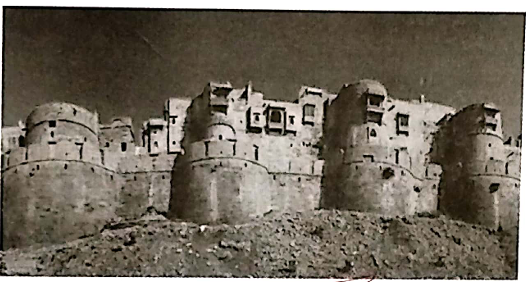
This is a mud structure built in the 12th century and refurbished later using sandstone. Identify it.
(A) Gwalior Fort, Madhya Pradesh
(B) Mehrangarh Fort, Rajasthan
(C) Jaisalmer Fort, Rajasthan
(D) Agra Fort, Uttar Pradesh
3. Which of the following terms refers to an idea from the Bhagavad Gita signifying that everyone must transcend personal desires and act for the wellbeing of all?
(A) Swadharma
(B) Lokasangraha
(C) Karma Yoga
(D) Mahat-tattva
4. River water stays a renewable resource as long as ……………….. and ……………….. exist. Choose the correct terms for the blanks.
(A) animals and plants
(B) glaciers and forests
(C) mountains and humans
(D) water and petroleum
5. The concept of stewardship refers to:
(A) Ownership of land
(B) Destruction of nature
(C) Responsible use of resources
(D) Collection of taxes
6. Over exploitation of groundwater is a major issue in:
(A) Sikkim
(B) Gujarat
(C) Assam
(D) Punjab
7. Which of the following is a ‘renewable resource’?
(A) Natural gas (B) Petroleum (C) Wind (D) Coal
8. It has been estimated that the reserves of this resource in India may last another 50 years and we need to use the reserves we have, judiciously. Identify the resource.
(A) Copper (B) Iron (C) Gold (D) Coal
9. What has dissolved in the groundwater of Punjab and is causing health hazards?
(A) Mud water (B) Organic waste (C) Chemicals from pesticides and fertilisers (D) Household waste
10. Glaciers are melting. This has implications on water security for the populations living in the north Indian plains dependent on the ‘water tower’. ‘Water tower’ refers to: (
A) Ganga-Brahmaputra delta (B) The Himalayan mountains (C) The Andes (D) The Aravallis
B. Assertion-Reason Questions
In the questions given below, there are two statements marked as Assertion(A) and Reason(R). Read the statements and choose the correct option.
- Assertion(A): Punjab contributed to India becoming self-sufficient in food.
Reason(R): Punjab was home to the Green Revolution. (A) Both A and R are true and R is the correct explanation of A (Marked with a check and circled) (B) A is correct but R is incorrect (C) A is incorrect but R is correct (D) Both A and R are true but R is not the correct explanation of A
- Assertion(A): The production of cement has been listed as one of the most polluting industries.
Reason(R): The process of production produces fine dust that enters our lungs and those of animals, damaging them.
(A) Both A and R are true and R is the correct explanation of A
(B) A is correct but R is incorrect
(C) A is incorrect but R is correct
(D) Both A and R are true but R is not the correct explanation of A
C. Fill in the blanks using appropriate word(s):
- Nature resources are materials and substances that occur in Nature and are valuable to humans.
- Nature does not pay attention to political boundaries.
- A mature tree produces about 295 litres of oxygen per day.
- arghyam is offered to Surya, the Sun-God , in gratitude.
- Restoration is the process of returning something to its original healthy state if it has been degraded or damaged.
D. Match the columns.
Column A Column B
(a) Vrikshayurveda (v) (i) Polluting industry
(b) Bhadla Solar Park (iii) (ii) Punjab
(c) Cement (i)
(d) Tuna fish (iv)
(e) Over pumping of ground water (ii)
(iii) Rajasthan (iv) Ocean ecosystem balance (v) Ancient Indian plant science
E. Very Short Answer Type Questions Answer to each question should not exceed 40 words.
1. When do elements of nature become resources? Give an example.
answer: When human use these for their sustenance or creat new things from them for consumption these elements of nature become resources for example tree are part of the enviroment; they exist independently of human when we cut them and convert their wood into furniture we use the trees as a resource.
2. What is the result of industries disposing off waste into rivers?
answer: Often industries wastes cannot decay to become the food of some life form. Instead it leads to a disturbance in Nature’s cycle of restoration and regeneration leading to a situation where the river becomes poisonous and cannot support life.
3. What is the connection between the distribution of natural resources and different aspects of life?
answer: Natural resources are not evenly distributed across our planet even within countries This uneven distribution shapes human settlements, trade patterns, international relations and conflicts too Many wars have been fought and continue to be fought, to gain control over natural resources.
4. What are ecosystem services?
answer: Nature has some inherent ways of working for example tree naturally produce oxygen when these natural processes benefit human we call them ‘ecosystem services’
F. Short Answer Type Questions Answer to each question should not exceed 60 words.
1. What are ecosystem services? Provide two examples of how they benefit humans.
Answer:- Nature has some inherent ways of working. For example, trees naturally produce oxygen. When these natural processes benefit humans, we call them ‘ecosystem services’. When we benefit from clean water, protected farmland, and pollinated crops because of forests, we are receiving ecosystem services from nature.
2. What is the “natural resource curse” or “paradox of plenty” and how has India generally avoided it?
Answer:- The ‘paradox of plenty’, put very simply, means that often having an abundance of natural resources does not automatically make a country rich. Frequently, economies are unable to develop industries that convert these resources into products of higher value; the chapter ‘Factors of Production’ in the latter part of this book will give you an understanding of this. India has generally avoided this curse by investing in the development of such industries to meet our growing needs.
3. What have been the implications of uneven distribution of natural resources on human beings?
Answer:- We have examples from across the world. Industries located near natural resources create employment opportunities for local people. Townships grow around them and expand economic opportunities for them, too, as more of life’s necessities become accessible. However, these benefits are often accompanied by costs, in the short term as well as in the long term.
G. Long Answer Type Questions Answer to each question should not exceed 120 words
1. How did the Green Revolution in Punjab contribute to the current crisis of groundwater depletion and chemical contamination?
In the 1960s, farmers shifted to high-yielding varieties of wheat and paddy. These required more water than traditional seeds, and farmers began to extract groundwater to meet this need. In addition, the supply of free power led to the over-pumping of groundwater (a situation still prevalent in much of India today). Modern farming techniques also required the use of chemical pesticides and fertilizers. The combined effect of these factors is that the groundwater level in a large part of Punjab (see fig 1.17) has become inaccessible at depths of up to 30 meters. Furthermore, chemicals from pesticides and fertilizers have dissolved into the ground, causing health hazards. Almost 80% of the area of Punjab has been classified as over-exploited; in other words, water is drawn at a rate much greater than that at which the restoration and regeneration of groundwater is possible.
2. Explain Nature’s cycle of restoration and regeneration.
A general principle of nature is that it functions in a restorative and regenerative way. Restoration is the process of returning something to its original healthy state if it has been degraded or damaged. Regeneration goes beyond restoration. It is about nature’s ability to create new life and the conditions for it to thrive. Nature works in cycles where there is no waste. Take a forest, for example. Let’s say a tree falls in the forest. It decomposes, with bacteria, fungi, and insects feeding on it. Then, the tree becomes part of the soil, enriching it. New trees and plants grow from seeds. Eventually, some will fall, and the cycle starts again. These are examples of nature’s principles of restoration and regeneration in practice.