
My next-door neighbour, Mrs. Jones,
has got a garden full of stones:
A crazy path, a lily pond,
a rockery and, just beyond
A sundial with a strange device,
which Mrs. Jones thinks rather nice.
My next-door neighbour, Mrs. Jones,
puts little plants between the stones
They are so delicate and small,
they don’t mean anything at all.
I can’t think how she gets them in,
unless she plants them with a pin.
My next-door neighbour, Mrs. Jones,
once asked me round to see her stones.
We stood and talked about a flower
for quite a quarter of an hour.
“Where is this lovely thing?” I cried.
“You’re standing on it,” she replied.
Reginald Arkell
A Concrete Example: Questions and Answers
Let Us Discuss
I. Complete the following summary with exact words from the poem.
The poem describes Mrs. Jones, the speaker’s next-door neighbour, who has a unique garden filled with stones. Her garden includes a peculiar path, a pond, and a rockery, along with an unusual sundial that she finds charming. Mrs. Jones plants tiny, delicate plants between the stones, which the speaker thinks must be so small that they are planted with a pin. One day, Mrs. Jones invites the speaker to see her garden, and they discuss a flower that Mrs. Jones treasures. When the speaker asks where the lovely flower is, Mrs. Jones says that the speaker has been standing on it all along.
II. Select the correct option to fill in the blanks for the following sentences.
1. The tone of the poem is ____________.
(i) mocking
(ii) humorous
(iii) mournful
(iv) amusing
(v) light-hearted
Answer: D. (ii), (iv), and (v)
2. The speaker in the poem is ____________.
(i) Mrs. Jones
(ii) the poet
(iii) a gardener
(iv) a child
Answer: (ii) the poet
3. The rhyme scheme of the poem is _________.
(i) AABBCC
(ii) ABABCC
(iii) AABCAC
(iv) ABBACC
Answer: (i) AABBCC
III. Complete the following sentences by choosing the correct answer given in the brackets.
1. The poet uses the word ‘stones’ in all stanzas in order to emphasise her ________. (obsession with a stony garden/pride in gardening skills)
Answer: obsession with a stony garden
2. The poet uses imagery to describe the features of the garden that help readers _____________. (understand Mrs. Jones’ love for plants/visualise the garden’s peculiar nature)
Answer: visualise the garden’s peculiar nature
IV. Pick examples of alliteration from the poem.
Answer:
- “plants them with a pin”
- “quite a quarter”
- “stood and talked about a flower for quite a quarter of an hour”
V. A refrain is a repeated line or phrase that appears in each stanza. Identify the refrain from the poem.
Answer: “My next-door neighbour, Mrs. Jones,”
VI. Irony is a literary device that emphasises the difference between what is expected and what actually happens. Identify the line(s) from the poem that display(s) situational irony.
Answer: “Where is this lovely thing?” I cried. “You’re standing on it,” she replied.
VII. Complete the following sentences appropriately.
1. The word ‘concrete’ can refer to ______________ in Mrs. Jones’ garden.
Answer: the actual stones and pathways
2. The title also has a symbolic meaning, as the poem provides a clear or ‘concrete’ example of Mrs. Jones’ ______________ gardening habits.
Answer: unusual
Let Us Think and Reflect
I. Read the given extract and answer the questions that follow.
My next-door neighbour, Mrs. Jones,
has got a garden full of stones:
A crazy path, a lily pond,
a rockery and, just beyond
A sundial with a strange device,
which Mrs. Jones thinks rather nice.
(i) What can be inferred about Mrs. Jones’s taste in gardening from the description of her garden being ‘full of stones’? Answer: Mrs. Jones likes a unique and creative garden made with stones instead of traditional, lush greenery.
(ii) Identify whether the following statement is true or false. The garden serves as a means to reveal more about Mrs. Jones herself.
Answer: True.
(iii) What does the poet mean by ‘crazy path’?
Answer: It refers to a randomly paved walkway made of irregular stones, which mirrors a non-linear or eccentric personality.
(iv) What does the sundial with a ‘strange device’ suggest about Mrs. Jones’ personality?
Answer: A. She has a fascination with unusual items.
II. Answer the following questions.
1. How does Mrs. Jones feel about her garden? Support your answer with evidence from the poem.
Answer: Mrs. Jones feels very proud of her special garden. The poem shows she finds beauty in its small and tiny details, as evidenced by her inviting the speaker over specifically to “see her stones” and talking about a single, tiny flower for fifteen minutes.
2. Why do you think the speaker describes the plants as being so small that they could be planted with a pin?
Answer: The speaker uses this humorous exaggeration (hyperbole) because the plants are extremely small, delicate, and difficult to see with the naked eye.
3. What do we get to know about Mrs. Jones—based on her gardening style and her interaction with the speaker?
Answer: We learn that Mrs. Jones is careful about small details, is a bit eccentric, and loves finding value in tiny things that others might completely overlook or step on.
4. The poem portrays Mrs. Jones in a positive light. Support this statement.
Answer: The poem shows her as someone with a keen, passionate interest in her hobbies. She is cheerful, welcoming (inviting her neighbor over), and happily shares her unique perspective on beauty without getting angry when the speaker accidentally steps on her flower.
5. What does the poem tell us about the way people think differently about the world around them?
Answer: It tells us that people find beauty in entirely different things. While the speaker expects a grand, visible flower, Mrs. Jones finds joy in something microscopic. It encourages respecting and understanding various perspectives.
Let Us Learn
I. Select the appropriate word from the brackets that correctly replaces the underlined word in the sentences from the text.
1. A sundial with a strange device, (unusual, peculiar, new, rare, external)
Answer: peculiar
2. … which Mrs. Jones thinks rather nice. (pleasant, superior, agreeable, gentle, charming)
Answer: charming
3. They are so delicate… (delicious, fragile, dainty, graceful, weak)
Answer: dainty
4. “Where is this lovely thing?” I cried. (exclaimed, wept, shouted, announced, whispered)
Answer: exclaimed
II. The ‘sundial’ is referred to as a ‘device’ in the poem. Work in pairs to infer the meaning of ‘device’. Share your thoughts with your classmates and teacher.
Now, match the type of instruments in Column 1 with their definitions in Column 2. Column 3 shows one example of each type of instrument. Add more examples in Column 3.
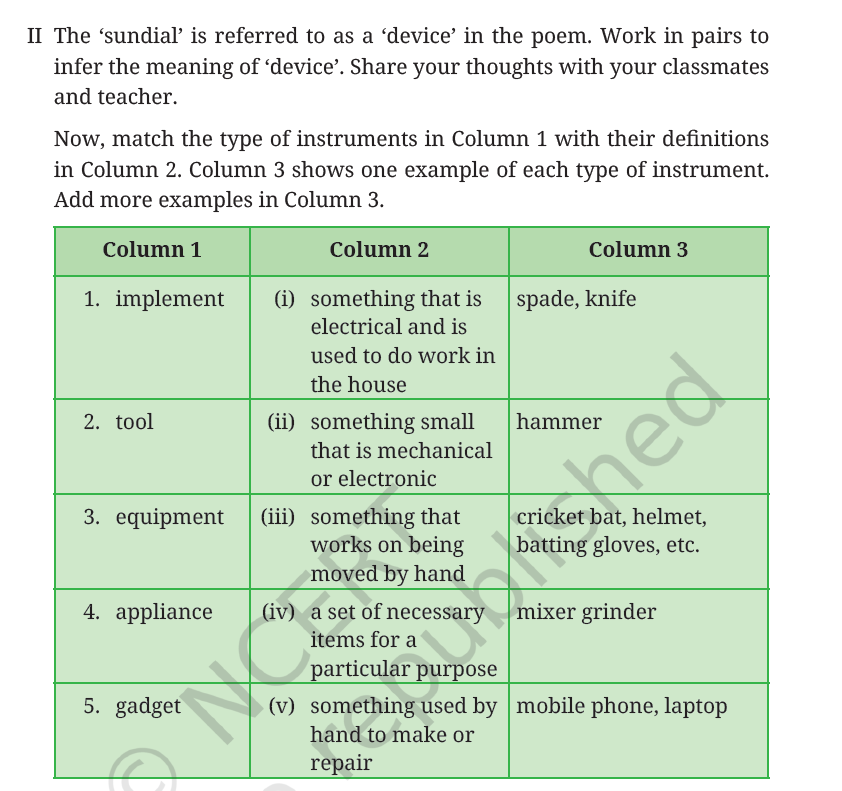
| Column 1 (Instrument) | Column 2 (Definition) | Column 3 (Examples) |
| 1. implement | (iii) something that works on being moved by hand | spade, knife, rake, sickle, pitchfork |
| 2. tool | (v) something used by hand to make or repair | hammer, screwdriver, wrench, pliers |
| 3. equipment | (iv) a set of necessary items for a particular purpose | cricket bat, helmet, batting gloves, camping tent, scuba gear |
| 4. appliance | (i) something that is electrical and is used to do work in the house | mixer grinder, refrigerator, washing machine, microwave |
| 5. gadget | (ii) something small that is mechanical or electronic | mobile phone, laptop, smartwatch, digital camera, tablet |
III. Complete the table by making new words.
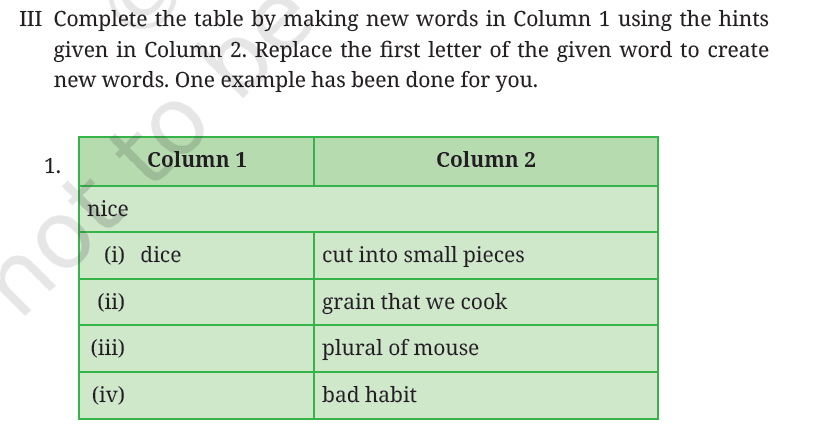
Answer:-
| Column 1 | Column 2 (Hint) |
| nice | |
| (i) dice | cut into small pieces |
| (ii) rice | grain that we cook |
| (iii) mice | plural of mouse |
| (iv) vice | bad habit |
1
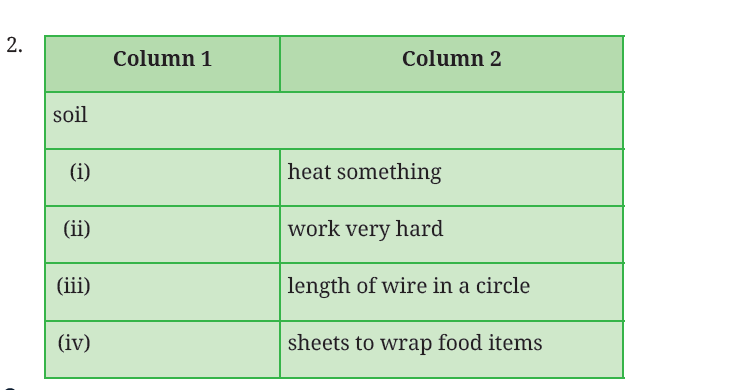
. Answer:-
| Column 1 | Column 2 (Hint) |
| soil | |
| (i) boil | heat something |
| (ii) toil | work very hard |
| (iii) coil | length of wire in a circle |
| (iv) foil | sheets to wrap food items |
Let Us Listen
You will listen to a presentation about the wonderful Rock Garden of Chandigarh. As you listen, answer the following questions using one to three exact words
1. Where was Nek Chand’s Rock Garden featured?
Answer: Chandigarh.
2. What kind of sculptures does the Rock Garden have?
Answer: Recycled material sculptures.
3. How is the Rock Garden divided? \
Answer: Interconnected courtyards.
4. Name any one thing that has been transformed into a piece of art in the Rock Garden.
Answer: Broken bangles (or ceramic tiles).
5. Approximately, how many statues border the Rock Garden?
Answer: Thousands.
Let Us Speak
I The speaker of the poem might have felt sorry for stepping on Mrs. Jones’
flower. When we make a mistake, we must express regret and apologise
for our actions.
- When we apologise to a friend or a family member, we use informal
language. Take turns to apologise for the following situations and
respond to the apology.
- (i) You have eaten your brother’s share of sweets.
- Apology: “I’m really sorry I ate your sweets. I didn’t realize they were yours.”
- Response: “That’s alright. Just leave some for me next time.”
- (ii) You have broken your sister’s flower craft.
- Apology: “Sorry, I didn’t mean to break your flower craft. I was just admiring it.”
- Response: “It’s no big deal. We can fix it together.”
- (iii) You accidentally spilled ink on your mother’s important documents.
- Apology: “Please forgive me for spilling ink on your papers, Mom. It was a complete accident.”
- Response: “These things happen. Let’s see if we can print a new copy.”
- (iv) You forgot to bring your friend’s notebook to the school after borrowing it.
- Apology: “I’m sorry about forgetting your notebook today. I’ll bring it first thing tomorrow!”
- Response: “No problem. I don’t need it today anyway.”
2. Formal Language (Authority Figures)
- When we apologise to someone in authority like a Principal or a teacher in a formal setting, we use formal language. Work in pairsand take turns to apologise for the following situations and respond to the apology.
- (i) You did not bring an assignment that was due for submission.
- Apology: “I owe you an apology for not bringing my assignment today. I’ll do my best not to repeat it.”
- Response: “I accept your apology. Please ensure you submit it by tomorrow morning.”
- (ii) You were late to school for the past three days and had to meet the Principal.
- Apology: “I’m extremely sorry for being late these past three days. I promise it won’t happen again.”
- Response: “I appreciate you saying this, but you must improve your time management.”
- (iii) You did not submit your project work and were asked to explain.
- Apology: “I really regret missing the project deadline. I assure you that this will never happen again.”
- Response: “I accept your apology. Please ensure you complete the work over the weekend.”