
Taken from the notebook of Miss. Aradhya Apte, Class VII, Vidya Vihar School Chandrapur
The Day the River Spoke
Q1: What does the repetition of the phrase “I couldn’t” tell us?
Ans: The repetition suggests Jahnavi’s hesitation, fear, or internal conflict. It emphasizes her feeling of being stuck or unable to break free from her current situation or mindset.
Q2: Why does the writer describe different aspects of nature in great detail at the beginning of the story? Why do you think the writer does this?
Ans: The writer likely does this to establish a vivid setting and to create a specific atmosphere. By personifying nature (like the river), the writer sets the stage for the interaction between Jahnavi and her environment, suggesting that nature is a living, observing character in her daily life.
Q3: How did the river know so much about Jahnavi?
Ans: In many stories of this type, the river acts as an ancient, all-seeing entity that has watched Jahnavi grow up. It ‘knows’ her because it has observed her daily life, her struggles, and her routine over a long period of time.
Q4: Jahnavi says, “Let me go, and I’m so old now, they’ll never…” What can we infer about Jahnavi and the school from this line?
Ans: This suggests that Jahnavi feels trapped by her responsibilities and her age. She perceives the rigid school (or her role within it) as an institution that she is bound to, indicating a lack of personal freedom and her belief that it is too late for her to change her life.
Q5: Why did the river laugh when Jahnavi said she would be scared at school?
Ans: The river likely laughs because, from its vast and eternal perspective, the fears of a human regarding a social institution like a school seem small or unnecessary. It might also see the irony of a grown woman being scared of a school environment.
Q6: Why should Jahnavi follow the river’s advice?
Ans: The river represents flow, change, and freedom. Following its advice would mean letting go of her rigid fears and moving forward with her life, just as a river constantly moves forward to the sea.
Q7: How does the conversation between Jahnavi and the river make the story more appealing?
Ans: The conversation uses personification, making the river feel like a living, breathing character. This adds a magical, fairy-tale quality to the story and allows the reader to understand Jahnavi’s deepest thoughts and feelings through their dialogue.
Q9: What is the main message that the writer intends to convey?
Ans: The main message is about overcoming fear and self-doubt. It encourages readers to be brave when facing new situations (like starting school) and highlights the supportive connection between humans and nature
Q1: Discuss why rivers in India are considered sacred and why most of them are referred to as female. Some rivers are referred to as male, for example, the Brahmaputra.
Ans: The rivers in India are considered sacred because they give life, provide water for crops, and are a part of religious stories. Many rivers, like the Ganga and Yamuna, are seen as female goddesses who nurture and protect. Some, like the Brahmaputra, are called male, possibly due to their strength or myths associating them with the masculine world.
Beautiful Nature
Every day, I see different aspects of nature around me, with green trees, colourful flowers, birds, and butterflies. The fresh air and sunlight make everything look calm and peaceful. I find it very interesting that nature has many colours and shapes. I feel happy and relaxed when I see nature because it gives me peace. We should love and protect nature, plant more trees, and help keep our surroundings clean
Poster Heading: Read the poster given below and answer the questions that follow. “The Happiness of a Nation lies in the Dignity of its Daughters.
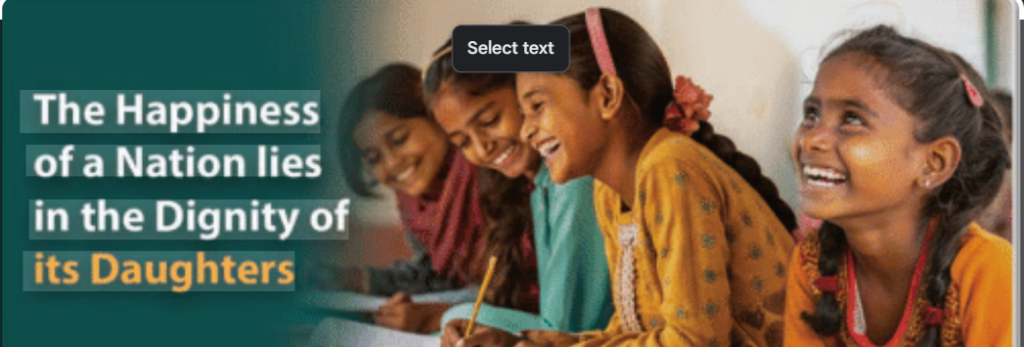
Poster Heading: Read the poster given below and answer the questions that follow. “The Happiness of a Nation lies in the Dignity of its Daughters.”
Q1: What are the things you can observe in the poster?
Ans: I see happy girls studying.
Q2: Why do you think the girls look happy?
Ans: The girls look happy because they are getting an education and are treated with respect.
Q3: Dignity means ‘self-respect’. What is the relationship between dignity and happiness?
Ans: Dignity means self-respect. When girls are treated with respect, they feel confident and happy, so dignity leads to happiness.
Q4: How does a nation prosper when its daughters are educated/happy?
Ans: When daughters are happy and educated, they help in the progress of society, so the nation prospers.
IV The government has launched many schemes for the education of the girl child. Some of them are ‘Beti Bachao Beti Padhao’, ‘Balika Samridhi Yojana’, ‘Samagra Shiksha – Kasturba Gandhi Balika Vidyalayas’, etc.
Find out more such schemes from the internet or from your teacher and spread awareness in your neighbourhood.
- Schemes: Sukanya Samriddhi Yojana / CBSE Udaan Scheme / National Scheme of Incentive to Girls for Secondary Education.
- Conclusion: We can spread awareness by telling people about these schemes and encouraging them to send girls to school.