
In ∆PQR, PM = 15, PQ = 25 PR = 20, NR = 8. State whether line NM is parallel to side RQ. Give reason..
Practice Set 1.2 | Q 2 | Page 13
In ∆PQR, PM = 15, PQ = 25 PR = 20, NR = 8. State whether line NM is parallel to side RQ. Give reason..
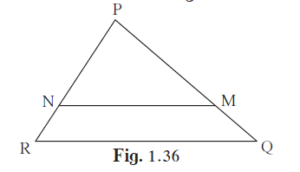
Solution
Given: PM = 15, PQ = 25, PR = 20 and NR = 8
PQ = PM + MQ
25 = 15 + MQ
⇒ MQ = 25 – 15 = 10
⇒ MQ = 10
PQ = PM + MQ
25 = 15 + MQ
⇒ MQ = 25 – 15 = 10
⇒ MQ = 10
PR = PN + NR
20 = PN + 8
⇒ PN = 20 – 8
⇒ PN = 12
`”PM”/”MQ” = 15/10 = 3/2`
`”PN”/”NR” = 12/8 = 3/2`
In ΔPQR,
`”PM”/”MQ” = “PN”/”NR”`
By converse of basic proportionality theorem, NM is parallel to side RQ or NM || RQ.
Soution:-
Given: PM = 15, PQ = 25, PR = 20, and NR = 8.
First, we find MQ and PN:
- PQ = PM + MQ, so 25 = 15 + MQ. Therefore, MQ = 10.
- PR = PN + NR, so 20 = PN + 8. Therefore, PN = 12.
Then, we calculate the ratios of PM to MQ and PN to NR:
- PM/MQ = 15/10 = 3/2
- PN/NR = 12/8 = 3/2
Since the ratios are equal, we can apply the converse of the basic proportionality theorem to conclude that NM is parallel to RQ, or NM || RQ.
Chapter 1. Similarity- Practice Set 1.2 – Page 13
Click Here for All Textbook Soutions of Chapter 1: Similarity