
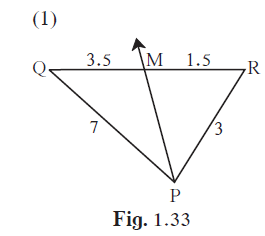
Given below are some triangles and lengths of line segments. Identify, ray PM is the bisector of ∠QPR.
Practice Set 1.2 | Q 1.1 | Page 13
Given below are some triangles and lengths of line segments. Identify, ray PM is the bisector of ∠QPR.
Solution
In ∆ PQR,
PQ = 7, PR = 3, QM = 3.5, and MR = 1.5 …(Given)
PQ = 7, PR = 3, QM = 3.5, and MR = 1.5 …(Given)
`”PQ”/”PR” = 7/3` …(i)
`”QM”/”MR” = 3.5/1.5 = (3.5 × 10)/(1.5 × 10) = 35/15 = 7/3` …(ii)
From (i) and (ii)
∴ `”PQ”/”PR” = “QM”/”MR”`
∴ by converse of angle bisector theorem,
∴ Ray PM is the bisector of ∠QPR.
Solution:-
The statement provides information about a triangle PQR and its side lengths and ratios.
It is given that PQ = 7, PR = 3, QM = 3.5, and MR = 1.5.
The statement then shows that PQ/PR = 7/3 and QM/MR = 3.5/1.5 = 7/3.
Using these ratios, it can be deduced that PQ/PR = QM/MR. By the converse of the angle bisector theorem, this means that Ray PM is the bisector of angle QPR.
Chapter 1. Similarity- Practice Set 1.2 – Page 13
Click Here for All Textbook Soutions of Chapter 1: Similarity