
Class 9 Ganita Manjari CBSE New Syllabus
Page 5: Exercise Set 1.1 & Think and Reflect
Fig. 1.3 shows Reiaan’s room with points OABC marking its corners. The x- and y-axes are marked in the figure. Point O is the origin
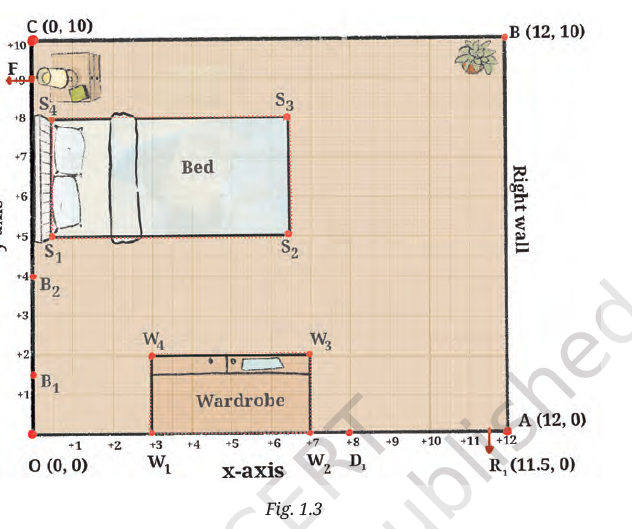
Referring to Fig. 1.3, answer the following questions:
(i) If D1R1 represents the door to Reiaan’s room, how far is the door from the left wall (the y-axis) of the room? How far is the door from the x-axis?
Answer: The door starts at point , which is located at on the x-axis. The left wall is the y-axis Therefore, the door is 8 units (feet) from the left wall. Because the door lies exactly on the x-axis, its distance from the x-axis is 0 units.
(ii) What are the coordinates of ?
Answer: Since is situated exactly on the x-axis at the 8-unit mark, its coordinates are .
(iii) If R1 is the point (11.5, 0), how wide is the door? Do you think this is a comfortable width for the room door? If a person in a wheelchair wants to enter the room, will he/she be able to do so easily?
Answer: The width of the door is the distance from D1(8,0) to R1(11.5,0), which isThis is indeed a very comfortable width. Standard wheelchairs are typically 24 to 27 inches wide (about 2 to 2.25 feet), so a 3.5-foot door provides more than enough clearance for easy access.
(iv) If B1 (0, 1.5) and B2 (0, 4) represent the ends of the bathroom door, is the bathroom door narrower or wider than the room door?
Answer: The width of the bathroom door is the distance between and , which isSince the room door is 3.5 feet wide, the bathroom door is narrower.
Think and Reflect:
Que :- What are the standard widths for a room door? Look around your home and in school.
Answer: Standard interior room doors are usually between 30 and 36 inches wide (2.5 to 3 feet).
Que:- Are the doors in your school suitable for people in wheelchairs?
Answer: Typically, yes. Modern accessibility guidelines (like the ADA) require doors to have a minimum clear width of 32 inches to comfortably accommodate wheelchairs.
Page 7: Think and Reflect
Que:- What is the x-coordinate of a point on the y-axis?
Answer: The x-coordinate of any point on the y-axis is always
Que:- Is there a similar generalisation for a point on the x-axis?
Answer: Yes, the y-coordinate of any point situated on the x-axis is always .
Que:- Does point ever coincide with point ? Justify your answer.
Answer: They only coincide if .
A coordinate pair represents a specific location where order matters.
For example, the point is in an entirely different location than .
However, if the values are identical (e.g., ), swapping them doesn’t change the location.
Que:- If then ; and if and only if . Is this claim true?
Answer: Yes, this claim is entirely mathematically accurate.
Pages 7–8: Exercise Set 1.2
On a graph sheet, mark the x-axis and y-axis and the origin O. Mark points from (– 7, 0) to (13, 0) on the x-axis and from (0, – 15) to (0, 12) on the y-axis. (Use the scale 1 cm = 1 unit.) Using Fig. 1.5, answer the given questions.
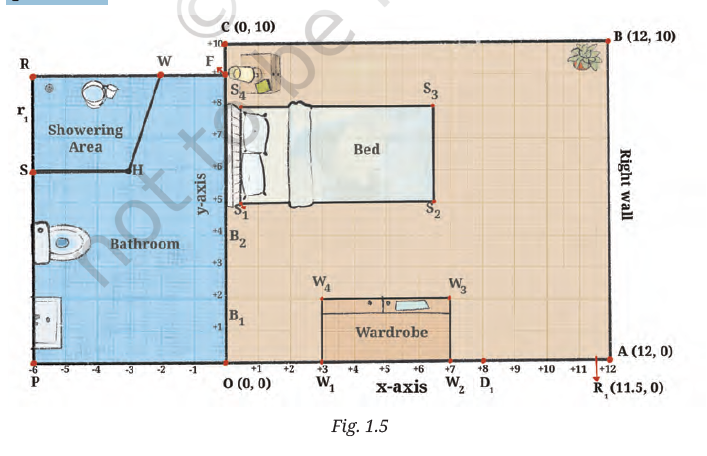
- Place Reiaan’s rectangular study table with three of its feet at the points (8, 9), (11, 9) and (11, 7).
(i) Where will the fourth foot of the table be?
Answer: To form a rectangle aligned with the axes, the points must share x and y coordinates. We have x-coordinates 8 and 11, and y-coordinates 7 and 9. The missing combination to complete the rectangle is and . Thus, the fourth foot is at .
(ii) Is this a good spot for the table?
Answer: Looking at Fig 1.5, the rectangle from x=8 to 11 and y=7 to 9 is tucked in the upper right corner of the bedroom. It sits neatly out of the main walking path, making it a highly practical spot.
(iii) What is the width of the table? The length? Can you make out the height of the table?
Answer:
Length:
Width:You cannot determine the height from this 2-D floor plan.
2. If the bathroom door has a hinge at and opens into the bedroom, will it hit the wardrobe? Are there any changes you would suggest if the door is made wider?
Answer: The hinge is at and the door width is . The wardrobe’s closest corner is at . If the door swings open, it forms a quarter-circle with a radius of 2.5 ft from B1.
Since 3.04>2.5, the door will not hit the wardrobe. If the door were made wider (e.g., or more), the clearance would become uncomfortably tight or it would collide. A sliding door or having the door swing outward would be better alternatives.
3. Look at Reiaan’s bathroom.
(i) What are the coordinates of the four corners O, F, R, and P of the bathroom?
Answer: Based on the map in Fig 1.5 and the dimensions , the coordinates are:
(ii) What is the shape of the showering area SHWR in Reiaan’s bathroom? Write the coordinates of the four corners.
Answer: It is a square. The coordinates are
It spans exactly
(iii) Mark off a 3 ft×2 ft space for the washbasin and a space for the toilet.
Answer:
Washbasin: (0,9),(−3,9),(−3,7),(0,7)
Toilet: (−6,0),(−4,0),(−4,3),(−6,3)
4. Other rooms in the house:
(i) (i) Reiaan’s room door leads from the dining room which has the length 18 ft and width 15 ft. The length of the dining room extends from point P to point A. Sketch the dining room and mark the coordinates of its corners
Answer:
(ii) (ii) Place a rectangular 5 ft × 3 ft dining table precisely in the centre of the dining room. Write down the coordinates of the feet of the table.
Answer:
Center:
Feet coordinates:
Page 9: Think and Reflect
In moving from A (3, 4) to D (7, 1), what distance has been covered along the x-axis? What about the distance along the y-axis?
Can these distances help you find the distance AD?
Page 11: Think and Reflect
- What has remained the same and what has changed with this reflection?
Answer: The side lengths and y-coordinates remain the same. The x-coordinates change signs.
2. Would these observations be the same if ΔADM is reflected in the x-axis (instead of the y-axis)?
Answer: The x-coordinates remain the same, and the y-coordinates change signs.
Pages 12–14: End-of-Chapter Exercises
1.What are the x-coordinate and y-coordinate of the point of intersection of the two axes?
Answer:-
2.Point W has x-coordinate equal to – 5. Can you predict the coordinates of point H which is on the line through W parallel to the y-axis? Which quadrants can H lie in?
Answer:- Answer: Because the line is parallel to the y-axis, all points on it share the exact same x-coordinate. So, the coordinates of H are (-5, y), where y can be any real number. Depending on the value of \[y\], point H can lie in Quadrant II (if \[y > 0\]) or Quadrant III (if \[y < 0\]).
3.Consider the points R (3, 0), A (0, – 2), M (– 5, – 2) and P (– 5, 2). If
they are joined in the same order, predict:
(i) Two sides of RAMP that are perpendicular to each other.
Answer: Side AM and Side MP. Side AM is a horizontal line (y = -2) and Side MP is a vertical line (x = -5).
(ii) One side of RAMP that is parallel to one of the axes.
Answer: Side AM is parallel to the x-axis.
(iii) Two points that are mirror images of each other in one axis.
Which axis will this be?
Answer: Points M (-5, -2) and P (-5, 2) are mirror images across the x-axis because their x-coordinates match and their y-coordinates are opposite signs.
4. Plot point Z (5, – 6) on the Cartesian plane. Construct a right-angled triangle IZN and find the lengths of the three sides. (Comment: Answers may differ from person to person.)
Answer:- Answer: Let the right angle be at point I(5, 0) and point N be the origin (0, 0).
Side IN (Horizontal): 5 units, Side ZI (Vertical): 6 units
Side ZN (Hypotenuse): √(6² + 5²) = √(36 + 25) = √61 units (approx. 7.81)
5. What would a system of coordinates be like if we did not have negative numbers? Would this system allow us to locate all the points on a 2-D plane?
Answer: Without negative numbers, we would be restricted entirely to the first quadrant. No, this system would not allow us to locate all points on a full 2-D plane.
6. Are the points M (– 3, – 4), A (0, 0) and G (6, 8) on the same straight line? Suggest a method to check this without plotting and joining the points.
Answer: Yes. A reliable method is to calculate the slope.
- Slope from M to A: (0 – (-4)) / (0 – (-3)) = 4/3
- Slope from A to G: (8 – 0) / (6 – 0) = 8/6 = 4/3 Since both slopes are 4/3, they lie on the exact same straight line.
7. Use your method (from Problem 6) to check if the points R (– 5, – 1), B (– 2, – 5) and C (4, – 12) are on the same straight line. Now plot both sets of points and check your answers.
Answer: * Slope of RB: (-5 – (-1)) / (-2 – (-5)) = -4/3
- Slope of BC: (-12 – (-5)) / (4 – (-2)) = -7/6 Because -4/3 ≠ -7/6, the points are not on the same straight line.
8. Using the origin as one vertex, plot the vertices of:
(i) A right-angled isosceles triangle.
Answer:- (0,0),(5,0),(0,5)
(ii) An isosceles triangle with one vertex in Quadrant III and the other in Quadrant IV.
Answer:-
(ii)
*9. The following table shows the coordinates of points S, M and T. In each case, state whether M is the midpoint of segment ST. Justify your answer.
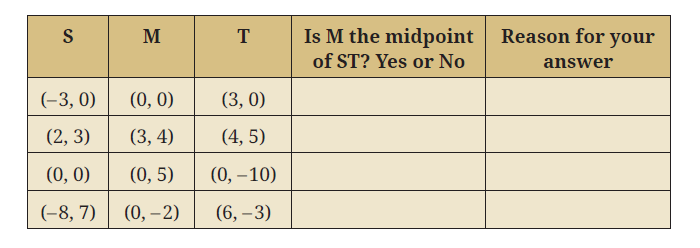
When M is the mid-point of ST, can you find any connection between the coordinates of M, S and T?
Answer:- Row 1: S(-3, 0), M(0, 0), T(3, 0) -> Yes. The average of -3 and 3 is 0.
Row 2: S(2, 3), M(3, 4), T(4, 5) -> Yes. (2+4)/2 = 3 and (3+5)/2 = 4.
Row 3: S(0, 0), M(0, 5), T(0, -10) -> No. The correct midpoint y is (0 + (-10))/2 = -5, not 5.
Row 4: S(-8, 7), M(0, -2), T(6, -3) -> No. The correct midpoint x is (-8 + 6)/2 = -1, not 0.
10. Use the connection you found to find the coordinates of B given that M (–7, 1) is the midpoint of A (3, – 4) and B (x, y).
Answer: For x: -7 = (3 + x)/2 => -14 = 3 + x => x = -17
For y: 1 = (-4 + y)/2 => 2 = -4 + y => y = 6 Coordinates of B: (-17, 6).
11. Let P, Q be points of trisection of AB, with P closer to A, and Q closer to B. Using your knowledge of how to find the coordinates of the midpoint of a segment, how would you find the coordinates of P and Q? Do this for the case when the points are A (4, 7) and B (16, –2).
Answer: P is the midpoint of A and Q. Q is the midpoint of P and B.
Let P=(x1, y1) and Q=(x2, y2).
x1 = (4 + x2)/2 and x2 = (x1 + 16)/2.
Solving gives x1 = 8 and x2 = 12.
y1 = (7 + y2)/2 and y2 = (y1 – 2)/2.
Solving gives y1 = 4 and y2 = 1.
Coordinates: P(8, 4) and Q(12, 1).
12.(i) Given the points A (1, – 8), B (– 4, 7) and C (–7, – 4), show that they lie on a circle K whose center is the origin O (0, 0). What is the radius of circle K?
Answer: Distance from the origin:
OA = √(1² + (-8)²) = √(1 + 64) = √65
OB = √((-4)² + 7²) = √(16 + 49) = √65
OC = √((-7)² + (-4)²) = √(49 + 16) = √65
Because all three points are √65 units away from the origin, they form a circle.
The radius is √65 (approx. 8.06).
(ii) Given the points D (– 5, 6) and E (0, 9), check whether D and E lie within the circle, on the circle, or outside the circle K.
Answer: OD = √((-5)² + 6²) = √61.
Since √61 < √65, point D lies within the circle. OE = √(0² + 9²) = √81 = 9.
Since 9 > √65, point E lies outside the circle.
13. The midpoints of the sides of triangle ABC are the points D, E, and F. Given that the coordinates of D, E, and F are (5, 1), (6, 5), and (0, 3), respectively, find the coordinates of A, B and C.
Answer: Let A=(x1, y1), B=(x2, y2), C=(x3, y3).
x1+x2 = 10, x2+x3 = 12, x3+x1 = 0.
Solving gives x1 = -1, x2 = 11, x3 = 1. y1+y2 = 2, y2+y3 = 10, y3+y1 = 6.
Solving gives y1 = -1, y2 = 3, y3 = 7.
The vertices are (-1, -1), (11, 3), and (1, 7).
14. A city has two main roads which cross each other at the centre of the city. These two roads are along the North–South (N–S) direction and East–West (E–W) direction. All the other streets of the city run parallel to these roads and are 200 m apart. There are 10 streets in each direction.
(i) Using 1 cm = 200 m, draw a model of the city in your notebook. Represent the roads/streets by single lines
(ii) There are street intersections in the model. Each street intersection is formed by two streets — one running in the N–S direction and another in the E–W direction. Each street intersection is referred to in the following manner: If the second street running in the N–S direction and 5th street in
the E–W direction meet at some crossing, then we call this street intersection (2, 5). Using this convention, find:
(ii) (a) how many street intersections can be referred to as (4, 3).
- Answer: Only one. A coordinate pair maps to a single, unique location.
(ii) (b) how many street intersections can be referred to as (3, 4).
- Answer: Only one.
15. A computer graphics program displays images on a rectangular screen whose coordinate system has the origin at the bottom-left corner. The screen is 800 pixels wide and 600 pixels high. A circular icon of radius 80 pixels is drawn with its centre at the point A (100, 150). Another circular icon of radius 100 pixels is drawn with its centre at the point B (250, 230). Determine:
(i) whether any part of either circle lies outside the screen.
Answer: The screen goes from 0 to 800 horizontally, and 0 to 600 vertically. Circle A’s lowest x is 100 – 80 = 20. Lowest y is 150 – 80 = 70. Circle B’s highest x is 250 + 100 = 350. Highest y is 230 + 100 = 330. Both are well within the 800 × 600 bounds, so no part lies outside the screen.
(ii) whether the two circles intersect each other.
Answer: Distance between centers A and B: AB = √((250 – 100)² + (230 – 150)²) = √(150² + 80²) = √(22500 + 6400) = √28900 = 170 pixels. The sum of their radii is 80 + 100 = 180 pixels. Because the distance (170) is less than the sum of radii (180), the two circles do intersect.
16. Plot the points A (2, 1), B (–1, 2), C (–2, –1), and D (1, –2) in the coordinate plane. Is ABCD a square? Can you explain why? What is the area of this square?
Answer: 1. Check side lengths:
AB = √((-1-2)² + (2-1)²) = √(9+1) = √10
BC = √((-2 – (-1))² + (-1-2)²) = √(1+9) = √10
CD = √((1 – (-2))² + (-2 – (-1))²) = √(9+1) = √10
DA = √((2-1)² + (1 – (-2))²) = √(1+9) = √10
All four sides are equal.
2. Check the diagonals: AC = √((-2-2)² + (-1-1)²) = √(16+4) = √20
BD = √((1 – (-1))² + (-2-2)²) = √(4+16) = √20
Because sides and diagonals are equal, it is definitely a square.
3. Area = side × side = √10 × √10 = 10 square units.