
Practice Set 1.1
1. Write the following sets in the roster form:
(i) Set of even numbers
Solution:
A = {2, 4, 6, 8, …}
(ii) Set of even prime numbers from 1 to 50
Solution:
B = {2}
(iii) Set of negative integers
Solution:
C = {-1, -2, -3, …}
(iv) Seven basic sounds of a sargam (sur)
Solution:
D = {sa, re, ga, ma, pa, dha, ni}
2. Write the following symbolic statements in words:
(i) 4/3 ∈ Q
Solution:
4/3 belongs to the set Q.
Or, 4/3 is an element of the set Q.
(ii) -2 ∉ N
Solution:
-2 does not belong to the set N.
Or, -2 is not an element of the set N.
(iii) P = {p | p is an odd number}
Solution:
P is the set of all values of p such that p is an odd number.
3. Write two sets by listing method and by rule method:
Roster Form:
A = {1, 4, 9, 16, 25}
B = {2, 4, 6, 8, 10, 12}
Set Builder Form:
A = {x | x = n², n ∈ N, n < 6}
B = {y | y = 2n, n ∈ N, n < 7}
4. Write the following sets using the listing method:
(i) All months in the Indian solar year
Solution:
A = {Chitra, Vishaka, Jyestha, Aashaadha, Sravana, Bhaadrapada, Asvini, Kaarthika, Maarghasira, Pausa, Maagha, Phalguna}
(ii) Letters in the word ‘COMPLEMENT’
Solution:
B = {C, O, M, P, L, E, N, T}
(iii) Set of human sensory organs
Solution:
C = {ear, nose, tongue, skin, eye}
(iv) Set of prime numbers from 1 to 20
Solution:
D = {2, 3, 5, 7, 11, 13, 17, 19}
(v) Names of continents of the world
Solution:
E = {Asia, Africa, North America, South America, Europe, Antarctica, Australia}
5. Write the following sets using rule method:
(i) A = {1, 4, 9, 16, 25, 36, 49, 64, 81, 100}
Solution:
A = {x | x = n², n ∈ N, n ≤ 10}
(ii) B = {6, 12, 18, 24, 30, 36, 42, 48}
Solution:
B = {y | y = 6n, n ∈ N, n ≤ 8}
(iii) C = {S, M, I, L, E}
Solution:
C = {x | x is a letter of the word SMILE}
(iv) D = {Sunday, Monday, Tuesday, Wednesday, Thursday, Friday, Saturday}
Solution:
D = {y | y is a day of the week}
(v) X = {a, e, t}
Solution:
X = {y | y is a letter of the word “eat”}
or
X = {y | y is a letter of the word “tea”}
PRACTICE SET – 1.2 (Textbook Page No. 6)
(1) Decide which of the following are equal sets and which are not? Justify your answer.
A = {x | 3x – 1 = 2}
B = {x | x is a natural number but x is neither prime nor composite}
C = {x | x ∈ N, x < 2}
Solution:
A = {x | 3x – 1 = 2}
∴ A = {1}
B = {x | x is a natural number but x is neither prime nor composite}
∴ B = {1}
C = {x | x ∈ N, x < 2}
∴ C = {1}
Here, the elements of A, B and C are exactly the same.
∴ A = B = C
(2) Decide whether sets A and B are equal sets. Give reason for your answer.
A = Even prime numbers
B = {x | 7x – 1 = 13}
Solution:
A = Even prime numbers
∴ A = {2}
B = {x | 7x – 1 = 13}
7x = 14
x = 2
∴ B = {2}
Here, the elements of A and B are exactly the same.
∴ A = B
(3) Which of the following are empty sets? Why?
(i)
A = {a | a is a natural number smaller than zero}
Solution:
A = {a | a is a natural number less than zero}
There is no natural number less than zero.
∴ A = { }
Hence, A is an empty set.
(ii)
B = {x | x² = 0}
Solution:
x² = 0
⇒ x = 0
∴ B = {0}
Since B contains one element, it is not an empty set.
(iii)
C = {x | 5x – 2 = 0, x ∈ N}
Solution:
5x – 2 = 0
⇒ 5x = 2
⇒ x = 2/5
But 2/5 is not a natural number.
∴ C = { }
Hence, C is an empty set.
(4) Write with reasons, which of the following sets are finite or infinite.
(i)
A = {x | x < 10, x ∈ N}
Solution:
A = {1, 2, 3, 4, 5, 6, 7, 8, 9}
A contains 9 elements.
∴ A is a finite set.
(ii)
B = {y | y < –1, y ∈ I}
Solution:
B = {…, –5, –4, –3, –2}
The elements continue indefinitely.
∴ B is an infinite set.
(iii)
C = Set of all students of Std. 9 in your school.
Solution:
The number of students can be counted.
∴ C is a finite set.
(iv)
Set of people living in a village.
Solution:
The number of people living in a village can be counted.
∴ It is a finite set.
(v)
Set of all apparatus used in a laboratory.
Solution:
The number of apparatus can be counted.
∴ It is a finite set.
(vi)
Set of whole numbers.
Solution:
W = {0, 1, 2, 3, …}
The elements continue without end.
∴ It is an infinite set.
(vii)
Set of rational numbers.
Solution:
The set of rational numbers contains infinitely many elements.
∴ It is an infinite set.
PRACTICE SET – 1.3 (Textbook Page No. 11)
(1) If
A = {a, b, c, d, e},
B = {c, d, e, f},
C = {b, d},
D = {a, e}
then determine whether the following statements are true or false.
(i) C ⊆ B
Ans. False
(ii) A ⊆ D
Ans. False
(iii) D ⊆ B
Ans. False
(iv) D ⊆ A
Ans. True
(v) B ⊆ A
Ans. False
(vi) C ⊆ A
Ans. True
(2) Take the set of natural numbers from 1 to 20 as universal set and show sets X and Y using Venn diagram.
(i)
X = {x | x ∈ N, 7 < x < 15}
Solution:
X = {8, 9, 10, 11, 12, 13, 14}
(ii)
Y = {y | y ∈ N, y is a prime number between 1 to 20}
Solution:
Y = {2, 3, 5, 7, 11, 13, 17, 19}
(3)
U = {1, 2, 3, 7, 8, 9, 10, 11, 12}
P = {1, 3, 7, 10}
Then
(i) Draw Venn diagram for U, P and P’
(ii) Verify (P’)’ = P
Solution:
U = {1, 2, 3, 7, 8, 9, 10, 11, 12}
P = {1, 3, 7, 10}
∴ P’ = {2, 8, 9, 11, 12}
Again,
(P’)’ = {1, 3, 7, 10}
∴ (P’)’ = P
(4)
A = {1, 3, 2, 7}
Write any three subsets of set A.
Solution:
The following are subsets of A:
{1}, {2}, {3}, {7}
{1, 3}, {1, 2}, {1, 7}
{2, 3}, {2, 7}, {3, 7}
{1, 2, 3}, {1, 2, 7}, {1, 3, 7}, {2, 3, 7}
{1, 2, 3, 7}, ∅
Any three subsets are:
{1, 3}, {2, 7}, {1, 2, 3}
(5) (i) Write the subset relation between the sets.
P is the set of all residents in Pune.
M is the set of all residents in Madhya Pradesh.
I is the set of all residents in Indore.
B is the set of all residents in India.
H is the set of all residents in Maharashtra.
(ii) Which set can be the universal set for above sets ?
(i) Write the subset relation between the sets.
P = Set of all residents in Pune.
M = Set of all residents in Madhya Pradesh.
I = Set of all residents in Indore.
B = Set of all residents in India.
H = Set of all residents in Maharashtra.
Solution:
P ⊆ H
I ⊆ M
H ⊆ B
M ⊆ B
(ii) Which set can be the universal set for the above sets?
Solution:
Set B (Residents in India) can be taken as the universal set.
(6) Which set of numbers could be the universal set for the sets given below?
(i) A = set of multiples of 5, B = set of multiples of 7.
C = set of multiples of 12
A = Set of multiples of 5
B = Set of multiples of 7
C = Set of multiples of 12
Solution:
A = {5, 10, 15, 20, …}
B = {7, 14, 21, 28, …}
C = {12, 24, 36, 48, …}
N = {1, 2, 3, …}
W = {0, 1, 2, 3, …}
I = {…, -2, -1, 0, 1, 2, …}
For the given sets A, B and C, we can take Natural Numbers (N) or Whole Numbers (W) or Integers (I) as the universal set.
(ii) P = set of integers which are multiples of 4.
T = set of all even square numbers
P = Set of integers which are multiples of 4.
T = Set of all even square numbers.
Solution:
P = {4, 8, 12, 16, …}
T = {4, 16, 36, 64, …}
N = {1, 2, 3, …}
W = {0, 1, 2, 3, …}
I = {…, -2, -1, 0, 1, 2, …}
For the sets P and T, we can take Natural Numbers (N) or Whole Numbers (W) or Integers (I) as the universal set.
((7) Let all the students of a class is an Universal set. Let set A be the students who secure 50% or more marks in Maths. Then write the complement of set A.
Let all the students of a class be the universal set.
Let set A be the students who secure 50% or more marks in Mathematics. Write the complement of A.
Solution:
U = The set of all students in a class.
A = The set of students securing 50% and above marks in Mathematics.
∴ A’ = The set of students securing less than 50% marks in Mathematics.
PRACTICE SET – 1.4 (Textbook Page No. 16)
(1) If n(A) = 15, n(A ∪ B) = 29, n(A ∩ B) = 7 then find n(B).
Solution:
n(A ∪ B) = n(A) + n(B) – n(A ∩ B)
∴ 29 = 15 + n(B) – 7
∴ 29 = 8 + n(B)
∴ n(B) = 29 – 8
∴ n(B) = 21
(2) In a school hostel there are 125 students out of which 80 drink tea, 60 drink coffee and 20 drink both tea and coffee. Find the number of students who do not take tea or coffee.
Solution:
Method I:
Total number of students in school hostel = 125
∴ n(U) = 125
Let T be the set of students who drink tea.
∴ n(T) = 80
Let C be the set of students who drink coffee.
∴ n(C) = 60
20 students drink both tea and coffee.
∴ n(T ∩ C) = 20
n(T ∪ C) = n(T) + n(C) – n(T ∩ C)
= 80 + 60 – 20
= 120
Now,
n((T ∪ C)’) + n(T ∪ C) = n(U)
∴ n((T ∪ C)’)
= n(U) – n(T ∪ C)
= 125 – 120
= 5
∴ Number of students who do not take tea or coffee is 5.
Method II:
Number of students drinking at least one of the two drinks
= (80 – 20) + (60 – 20) + 20
= 60 + 40 + 20
= 120
Number of students who do not drink tea or coffee
= 125 – 120
= 5
(3) In a competitive exam 50 students passed in English, 60 students passed in Mathematics. 40 students passed in both the subjects. None of them fail in both the subjects. Find the number of students who passed at least in one of the subjects.
Solution:
Method I:
Let E be the set of students who passed in English.
∴ n(E) = 50
Let M be the set of students who passed in Mathematics.
∴ n(M) = 60
40 students passed in both subjects.
∴ n(E ∩ M) = 40
The number of students who passed at least in one subject is
n(E ∪ M)
= n(E) + n(M) – n(E ∩ M)
= 50 + 60 – 40
= 70
∴ Number of students who passed in at least one of the subjects = 70
Method II:
Number of students who passed in at least one subject
= (50 – 40) + (60 – 40) + 40
= 10 + 20 + 40
= 70
∴ Number of students who passed in at least one of the subjects is 70.
(4) A survey was conducted to know the hobby of 220 students of class IX. Out of which 130 students informed about their hobby as rock climbing and 180 students informed about their hobby as sky watching. There are 110 students who follow both the hobbies. Then how many students do not have any of the two hobbies? How many of them follow the hobby of rock climbing only? How many follow the hobby of sky watching only?
Solution:
Method I:
Let U be the set of all surveyed students of Std. IX.
∴ n(U) = 220
Let A be the set of students who like rock climbing.
∴ n(A) = 130
Let B be the set of students who like sky watching.
∴ n(B) = 180
110 students like both rock climbing and sky watching.
∴ n(A ∩ B) = 110
n(A ∪ B)
= n(A) + n(B) – n(A ∩ B)
= 130 + 180 – 110
= 200
Now,
n((A ∪ B)’)
= n(U) – n(A ∪ B)
= 220 – 200
= 20
Number of students who do not like rock climbing or sky watching is 20.
Number of students who like only rock climbing
= n(A) – n(A ∩ B)
= 130 – 110
= 20
Number of students who like only sky watching
= n(B) – n(A ∩ B)
= 180 – 110
= 70
Method II:
Number of students who like only rock climbing
= 130 – 110
= 20
Number of students who like only sky watching
= 180 – 110
= 70
Number of students who like either rock climbing or sky watching
= (130 – 110) + (180 – 110) + 110
= 20 + 70 + 110
= 200
Now, number of students who do not like rock climbing or sky watching
= 220 – 200
= 20
(5) Observe the given Venn diagram and write the following sets.
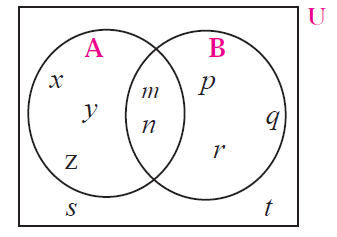
(i) A
Solution:
A = {x, y, z, m, n}
(ii) B
Solution:
B = {p, q, r, m, n}
(iii) A ∪ B
Solution:
A ∪ B = {x, y, z, m, n, p, q, r}
(iv) U
Solution:
U = {x, y, z, m, n, p, q, r, s, t}
(v) A’
Solution:
A’ = {p, q, r, s, t}
(vi) B’
Solution:
B’ = {x, y, z, s, t}
(vii) (A ∪ B)’
Solution:
(A ∪ B)’ = {s, t}
PROBLEM SET – 1 (Textbook Page No. 16)
(1) Choose the correct alternative answer for each of the following questions.
(i)
M = {1, 3, 5}, N = {2, 4, 6} then M ∩ N = ?
(A) {1, 2, 3, 4, 5, 6}
(B) {1, 3, 5}
(C) Φ
(D) {2, 4, 6}
Ans. (C)
(ii)
P = {x | x is an odd natural number, 1 < x ≤ 5}
How to write this set in roster form?
(A) {1, 3, 5}
(B) {1, 2, 3, 4, 5}
(C) {1, 3}
(D) {3, 5}
Ans. (D)
(iii)
P = {1, 2, …….., 10}
What type of set P is?
(A) Null set
(B) Infinite set
(C) Finite set
(D) None of these
Ans. (C)
(iv)
M ∪ N = {1, 2, 3, 4, 5, 6} and M = {1, 2, 4} then which of the following represent set N?
(A) {1, 2, 3}
(B) {3, 4, 5, 6}
(C) {2, 5, 6}
(D) {4, 5, 6}
Ans. (B)
(v)
If P ⊆ M, then which of the following set represent P ∩ (P ∪ M)?
(A) P
(B) M
(C) P ∪ M
(D) P’ ∩ M
Ans. (A)
(vi)
Which of the following sets are empty sets?
(A) Set of intersecting points of parallel lines.
(B) Set of even prime numbers.
(C) Month of an English calendar having less than 30 days.
(D) P = {x | x ∈ I, –1 < x < 1}
Ans. (A)
(2) Find the correct option for the given question.
(i)
Which of the following collections is a set?
(A) Colours of the rainbow
(B) Tall trees in the school campus
(C) Rich people in the village
(D) Easy examples in the book
Ans. (A)
(ii)
Which of the following set represent N ∩ W?
(A) {1, 2, 3, …}
(B) {0, 1, 2, 3, …}
(C) {0}
(D) I
Ans. (A)
(iii)
P = {x | x is a letter of the word ‘Indian’} then which one of the following is set P in listing form?
(A) {i, n, d}
(B) {i, n, d, a}
(C) {i, n, d, i, a}
(D) {n, d, a}
Ans. (B)
(iv)
If T = {1, 2, 3, 4, 5} and M = {3, 4, 7, 8} then T ∪ M = ?
(A) {1, 2, 3, 4, 5, 7}
(B) {1, 2, 3, 7, 8}
(C) {1, 2, 3, 4, 5, 7, 8}
(D) {3, 4}
Ans. (C)
(3) Out of 100 persons in a group, 72 persons speak English and 43 persons speak French. Each one out of 100 persons speaks at least one language. Then how many speak only English? How many speak only French? How many speak English and French both?
Solution:
Let E be the set of persons who can speak English.
∴ n(E) = 72
Let F be the set of persons who can speak French.
∴ n(F) = 43
100 persons can speak at least one language.
∴ n(E ∪ F) = 100
The number of persons who can speak both English and French
n(E ∩ F) = ?
n(E ∪ F) = n(E) + n(F) – n(E ∩ F)
100 = 72 + 43 – n(E ∩ F)
100 = 115 – n(E ∩ F)
n(E ∩ F) = 115 – 100
∴ n(E ∩ F) = 15
Number of persons who can speak only French
= n(F) – n(E ∩ F)
= 43 – 15
= 28
Number of persons who can speak only English
= n(E) – n(E ∩ F)
= 72 – 15
= 57
(4) 70 trees were planted by Parth and 90 trees were planted by Pradnya on the occasion of Tree Plantation Week. Out of these, 25 trees were planted by both of them. How many trees were planted by Parth or Pradnya?
Solution:
Let A be the set of saplings planted by Parth.
∴ n(A) = 70
Let B be the set of saplings planted by Pradnya.
∴ n(B) = 90
25 saplings are planted by both of them.
∴ n(A ∩ B) = 25
Number of saplings planted either by Parth or Pradnya
n(A ∪ B)
= n(A) + n(B) – n(A ∩ B)
= 70 + 90 – 25
= 160 – 25
= 135
∴ Number of saplings planted by Parth or Pradnya are 135.
(5) If n(A) = 20, n(B) = 28 and n(A ∪ B) = 36 then find n(A ∩ B).
Solution:
n(A ∪ B) = n(A) + n(B) – n(A ∩ B)
36 = 20 + 28 – n(A ∩ B)
36 = 48 – n(A ∩ B)
n(A ∩ B) = 48 – 36
∴ n(A ∩ B) = 12
(6) In a class, 8 students out of 28 have a dog as their pet animal at home, 6 students have a cat as their pet animal. 10 students have both dog and cat as pet animal, then how many students do not have a dog or cat as their pet animal at home?
Solution:
Let A be the set of students having dog as a pet at home.
∴ n(A) = 8 + 10 = 18
Let B be the set of students having cat as a pet at home.
∴ n(B) = 6 + 10 = 16
10 students have both dog and cat as pet at home.
∴ n(A ∩ B) = 10
Number of students having either dog or cat as pet
n(A ∪ B)
= n(A) + n(B) – n(A ∩ B)
= 18 + 16 – 10
= 24
Number of students who do not have dog or cat as pet
= 28 – 24
= 4
∴ Number of students who do not have dog or cat as pet is 4.
(7) Represent the union of two sets by Venn diagram for each of the following.
(i)
A = {3, 4, 5, 7}
B = {1, 4, 8}
Solution:
A ∪ B = {1, 3, 4, 5, 7, 8}
(ii)
P = {a, b, c, e, f}
Q = {l, m, n, e, b}
Solution:
P ∪ Q = {a, b, c, e, f, l, m, n}
(iii) X = {x | x is a prime number between 80 and 100}
Y = {y | y is an odd number between 90 and 100}
Solution:
X = {83, 89, 97}
Y = {91, 93, 95, 97, 99}
∴ X ∪ Y = {83, 89, 91, 93, 95, 97, 99}
(8) Write the subset relations between the following sets.
X = Set of all quadrilaterals.
Y = Set of all rhombuses.
S = Set of all squares.
T = Set of all parallelograms.
V = Set of all rectangles.
Solution:
Y ⊆ T, Y ⊆ X
S ⊆ X, S ⊆ Y, S ⊆ T, S ⊆ V
T ⊆ X
V ⊆ X, V ⊆ T
(9) If M is any set, then write M ∪ Φ and M ∩ Φ.
Solution:
M ∪ Φ = M
M ∩ Φ = Φ
(10) Observe the Venn diagram and write the given sets U, A, B, A ∪ B, A ∩ B.
Solution:
U = {1, 2, 3, 4, 5, 7, 8, 9, 10, 11, 13}
A = {1, 2, 3, 5, 7}
B = {1, 5, 8, 9, 10}
A ∪ B = {1, 2, 3, 5, 7, 8, 9, 10}
A ∩ B = {1, 5}
(11) If n(A) = 7, n(B) = 13, n(A ∩ B) = 4 then find n(A ∪ B).
Solution:
n(A ∪ B) = n(A) + n(B) – n(A ∩ B)
= 7 + 13 – 4
= 20 – 4
∴ n(A ∪ B) = 16.