
Unit 1: Learning Together
The Day the River Spoke
Page 1: Let us do these activities before we read
I. Close your eyes and quietly listen to the sounds around you for a minute.
1. Are they trying to tell you something?
Answer: Yes, the sounds of nature or the bustling environment often tell us about the time of day, the weather, or the busyness of the people around us.
2. Do you think the things around you also listen to you all day long?
Answer: In a poetic sense, yes. Nature often feels like a silent listener to our thoughts and daily activities.
II. Jahnavi was a bright young girl who lived with her parents and three brothers in a coastal village in India. Her parents worked on the farm. She had a dream.
1. What could that dream be?
Answer: Jahnavi’s dream was to go to school and learn how to read, just like her elder brother Ettan and sister Meena.
2. How could she make her dream come true?
Answer: She could make her dream come true by finding the courage to attend school and expressing her strong desire to learn to the teacher, who could then convince her parents.
3. What is your dream? What can you do to make your dream come true?
Answer: My dream is to become a teacher. I can make it come true by studying hard, being observant, and helping my peers learn new things.
Page 3: Let us discuss
1. What was Jahnavi’s dream? Was it important to her? Why?
Answer: Jahnavi’s dream was to go to school to learn how to read. Yes, it was very important to her because she had a deeply curious mind; she wanted to know why spiders are yellow in yellow flowers, why bamboo trees rustle, and why baby fish become frogs.
2. Do you think the river can help her in fulfilling her dream? How?
Answer: Yes, the river helps her by acting as a wise friend. The river encourages her, builds her confidence by reminding her of her bravery, and advises her to just slip into the school quietly one morning to listen.
Page 6: Let us discuss
Complete the table given below with Jahnavi’s questions in Column 1 and the River’s answers in Column 2.
| Jahnavi’s Questions (Column 1) | The River’s Answers (Column 2) |
| “…why the moon always comes from behind the hills…?” | “It goes down towards the sea. I’ve seen; it always takes the same way—over the mountains and down to the sea, like me!” |
| “Can I do something?” | “Seems to me little girls can do as much as little boys—they swim as fast as little boys.” |
| “What are ships?” | “Big boats, so big that they can take hundreds of people, and they sail along the sea with lights that shine all night.” |
| “Will they come here?” | “I’m afraid not. Too large, you know.” |
Pages 7-8: Let us think and reflect
I. Read the extracts given below and answer the questions that follow.
1:“You shouldn’t cry, you know,” the voice went on. “And you really shouldn’t be scared, when you have been coming here to see me every day, well, almost every day.” She as puzzled. It was such a voice, like the river. It couldn’t be the river! “Well, tell me all about it,” said the River, for it was the River. “I’ve got to hurry to reach the sea, you know.”
(i) Complete the sentence with the correct option from those given in the brackets.
“ (i) The tone of the River in the given extract is ________ (assuring/sympathising)
Answer: assuring.
(ii) Select a phrase from the extract which shows that Jahnavi was a frequent visitor to the spot.
Answer: “…when you have been coming here to see me every day, well, almost every day.”
(iii) The use of an exclamation mark at the end of the line, ‘It couldn’t be the river!’ expresses:
Answer: D. disbelief.
(iv) Choose three qualities of the River highlighted in the extract from the words in the box given below.

Answer: affectionate, kind-hearted, thoughtful.
2. “Can I do something?” asked Jahnavi. “Well, it’s up to you,” said the River. “Seems to me little girls can do as much as little boys—they swim as fast as little boys. You just slip along one morning and sit there in
the school and listen to what’s going on, and maybe the teacher will let you stay.”
“I couldn’t,” gasped Jahnavi. “I couldn’t! They’d scare me! They’d chase me out.”
(i) Complete the sentence with an appropriate reason.
(i) According to the River, there was no difference between girls and boys because ________
Answer: they can swim as fast as little boys and do just as much.
(ii) Identify whether the following statement is true or false. The River encourages Jahnavi to have faith in herself and fulfill her desire to go to school.
Answer: True.
(iii) When the River suggests that Jahnavi should ‘slip along’, it means that she should move ________
A. quickly B. casually C. quietly D. confidently
Answer: C. quietly.
(iv) What does the repetition of the phrase ‘I couldn’t’ tell us?
Answer: It tells us that Jahnavi was extremely hesitant, fearful, and lacked the confidence to step into the school.
II. Answer the following questions.
1. Why does the writer describe different aspects of nature in great detail at the beginning of the story? Why do you think the writer does this?
Answer: The writer does this to establish Jahnavi’s deep connection with her natural surroundings. It sets a calm, magical tone and shows that Jahnavi is highly observant and curious about the world around her.
2. How did the River know so much about Jahnavi?
Answer: The River knew so much because Jahnavi used to visit the river bank almost every day and sit by the water.
3. Jahnavi says, “And I’m so old now, they’ll never let me go.” What can you infer about Jahnavi and the school from this line?
Answer: We can infer that Jahnavi is nearly ten years old and feels she has missed the appropriate age to begin schooling, as little children usually start much earlier.
4. Why did the River laugh when Jahnavi said she would be scared at school?
Answer: The River laughed because Jahnavi was brave enough to not be scared of the green lizard, the snake in the bamboo clump, or the loud trains rattling on the bridge, making her fear of a school seem ironic.
5. Why should Jahnavi follow the River’s advice?
Answer: She should follow the River’s advice because the River acts as a wise, encouraging friend who believes in her abilities and offers a practical, bold solution to achieve her dreams.
6. How does the conversation between Jahnavi and the River make the story more appealing?
Answer: It adds an element of magic and personification, making nature feel alive, comforting, and deeply connected to human emotions.
7. What is the main message that the writer intends to convey?
Answer: The main message is that education is an equal right for everyone, including girls, and that one must gather courage to overcome their fears and pursue their dreams.
Pages 8-12: Let us learn (Grammar & Vocabulary)
I. You have learnt that naming words are called nouns and only proper nouns begin with a capital letter. Why has the author used a capital letter for the ‘River’ even when it is a common noun?
(Clue: Has the River been given qualities of a human being?)
Answer: The author capitalized ‘River’ because the river is personified throughout the story; it speaks, gives advice, and acts as a wise character, treating it like a proper noun.
II There are a few words related to sound in the text. Pick the words from the text and write them next to the correct definition.
- made a high-pitched piercing sound: shrieked
- to cause liquid to strike or fall on something: splashed
- a low continuous background noise: murmuring
- cry with loud uncontrollable gasps: sob
- to make a soft dry sound, like paper or leaves moving: rustle
- took a short quick breath through the mouth due to surprise, pain or shock: gasped
- shaking rapidly to make continuous short, sharp sounds: rattling
- making a lot of noise: noisy
- made a long, high cry, usually because of pain or sadness: wailed
Now , fill in the blanks with suitable sound words from exercise (II).
The classroom grew (i) quiet as the students noticed the teacher carrying the answer papers. As the teacher turned the pages with a (ii) rustle, the children (iii) gasped wondering what comments awaited. Someone (iv) sobbed in frustration, and the (v) murmuring of the students steadily increased. Finally, when the teacher praised the students for their excellent performance, the students (vi) shrieked with excitement.
III The word ‘catamaran’ is used in the text. The word originates from Tamil language ‘kattu maram’ meaning ‘tied wood’. Find out the meanings of these words. From which Indian language these words were borrowed. An example has been given.
- karma (Sanskrit) 2. sahib 3. chutney 4. guru 5. verandah 6. jungle 7. areca 8. palanquin
- Karma (Sanskrit): The sum of a person’s actions (good or bad) in this and previous states of existence, viewed as deciding their fate in future existences.
- Sahib (Hindi/Urdu): A polite, respectful title for a man (similar to ‘sir’ or ‘master’), often used during the British era.
- Chutney (Hindi): A spicy, chopped or ground condiment made from fruits, vegetables, and herbs.
- Guru (Sanskrit): A spiritual teacher, guide, or master, especially in Hinduism or Buddhism.
- Verandah (Hindi/Portuguese): A roofed, open-sided porch or balcony extending along the outside of a building.
- Jungle (Hindi/Sanskrit): A land covered with dense forest, thick vegetation, or wilderness.
- Areca (Malayalam): A type of palm tree (Areca catechu) that produces the areca nut (betel nut).
- Palanquin (Malayalam/Tamil): A covered, box-like couch used in former times for carrying one person, typically borne on the shoulders of four or more men.
V. Solve the crossword puzzle based on words related to water transport. Across:
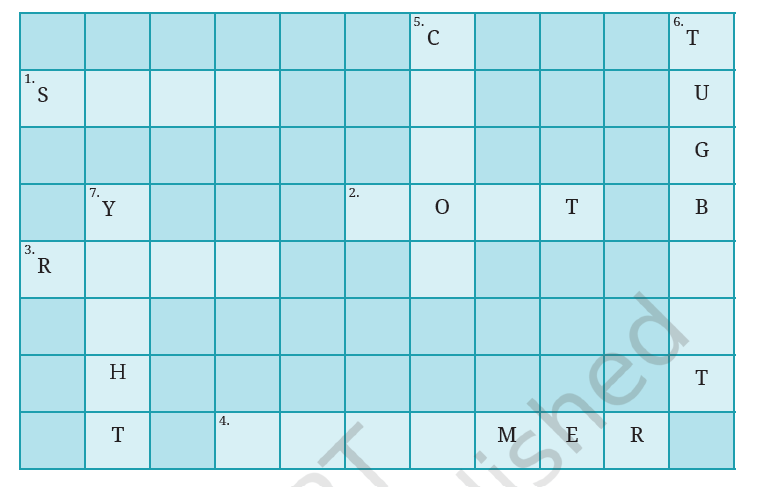
- a large vessel used for transporting goods or passengers by sea: SHIP
- a small vessel for travelling on water…: BOAT
- a flat floating structure…: RAFT
- a boat or ship driven by steam: STEAMER
Down: 5. a small, light, narrow boat…: CANOE
6. a boat with a powerful engine…: TUG
7. a boat with sails… rhymes with ‘cot’: YACHT
VI Read the highlighted words in the following lines from the text.
“She goes down towards the sea. I’ve seen her; she always takes the same way—over the mountains and down to the sea, like me!”
Prepositions are words that indicate the relationship between nouns or pronouns and other elements in a sentence. They show direction, location, time or logical relationships between ideas.
Now , fill in the blanks with suitable prepositions given within the brackets.
Jahnavi takes the River’s advice and goes to school. On her first day 1. at school, Jahnavi stood nervously 2. outside the gate, clutching her bag close to her. The bell rang and she hurried 3. inside the bustling classroom. She found a seat 4. between two friendly classmates. The teacher greeted them warmly and started the lesson 5. about numbers. Jahnavi listened attentively, feeling excited 6. about the new adventure ahead.
VII Read the highlighted words in the following sentence from the text.
A kingfisher swept down, its wings an arrow of blue in the sunlight.
Words like on, off, up, down can function both as preposition and as adverb.
For example:
- She ran up the stairs. (preposition)
- She rang me up. (adverb)
Fill in the blanks with prepositions or adverbs.
- The cat jumped off the table. (preposition)
- The children played outside until dark. (adverb)
- She quickly ran across the park. (preposition)
- The helicopter was hovering above. (adverb)
- We were just walking around chatting. (adverb)
- After thoroughly wiping his shoes, he stepped inside. (adverb)
- She drove slowly around the sharp curve. (preposition)
- He placed the keys under the mat before leaving. (preposition)
Page 12 II You will once again listen to the five speakers. As you listen, match each statement 1-7 to each speaker (i)-(v). There are two statements that you do not need.
Let us listen
I Read the words given in the box below. You will listen to five people speak about school life. As you listen, circle the words that are used by the speakers. There are two words you do not need.
Speaker(i): (Father) Should girls attend school? Yes, they should. I do my best to ensure that both my son and daughter get equal opportunities. I look forward to their successful careers and rewarding lives. I feel education gives freedom to make choices in life. Whether my daughter wants to work in an organisation or be a homemaker, it should be her choice and the same applies to my son.
Speaker(ii): (Grandmother) I went to school but many girls at that time could not attend school because some elders in the village felt that girls should help in the house and take care of their little brothers and sisters. I am happy that the situation has changed today.
Speaker(iii): (Teacher) The school prepares students for meaningful and useful participation in the world of work by learning hands-on abilities and skills, developing equal respect for head-hands-heart, valuing the dignity of labour, and understanding vocational choices for the future.
Speaker(iv): (Student) I like to go to school. I feel that by coming to school and reading the books, I learn about things from all over the world. I also have friends with whom I can share my feelings.
Speaker(v) : (Principal) Everyone should attend school. You must’ve noticed that the girls are doing very well. However, as the Head of an institution, I know that all students can work hard. My message to students is that they should attend school regularly and take part in every school activity without bothering whether it is for girls or boys. The idea is to focus on learning.
Statements Speaker No.
1. Promotes active participation for all participation fo in school activities speaker 5 principal
2. Comments on how school makes learning Mathematics joyful
3. Believes in the power of education that leads to freedom of choice Speaker 1 Father
4. Shares that school also means companionship Speaker 4 student
5. Understands that boys and girls have different abilities Speaker 3 Teacher
6. Persuades the parent to grant permission to attend school
7. Believes that learning skills is not gender-based Speaker 2 Grandmother
Page 13 Let us speak
II Janhavi asks the River for advice and the River gives
advice. Read the given situations and work in pairs to ask
for and give advice. Take turns to change your roles. Use
the prompts given below.
- Situation (i) : You wish to play football at school but it has an all-boys’ team only.
- Situation (ii) : You have been unable to score well in Mathematics due to nervousness
during exams. - Situation (iii) : You really enjoy music classes but do not get enough time to practise for it.
- Situation (iv) : You cannot see the blackboard clearly from the last bench.
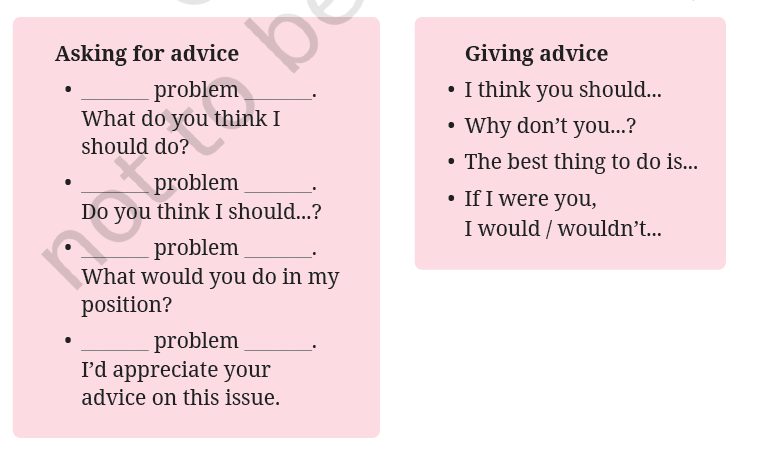
Situation (i): You wish to play football at school but it has an all-boys’ team only.
- Student A (Asking): I really wish to play football at school, but there is only an all-boys’ team. What do you think I should do?
- Student B (Giving): I think you should speak to the physical education teacher. You could ask them to either start a girls’ team or let you try out for the current team.
Situation (ii): You have been unable to score well in Mathematics due to nervousness during exams.
- Student A (Asking): I have been unable to score well in Mathematics due to nervousness during exams. What would you do in my position?
- Student B (Giving): If I were you, I would try some deep breathing exercises right before the test starts to help calm my nerves.
Situation (iii): You really enjoy music classes but do not get enough time to practise for it.
- Student A (Asking): I really enjoy my music classes, but I just don’t get enough time to practise. I’d appreciate your advice on this issue.
- Student B (Giving): The best thing to do is to create a daily schedule. Even just setting aside 15 minutes a day right after school can make a big difference.
Situation (iv): You cannot see the blackboard clearly from the last bench.
- Student A (Asking): I cannot see the blackboard clearly from the last bench. Do you think I should tell the teacher?
- Student B (Giving): Yes, why don’t you talk to the teacher after class and politely ask if you can be moved to one of the front desks?
Page 14 : Let Us Write
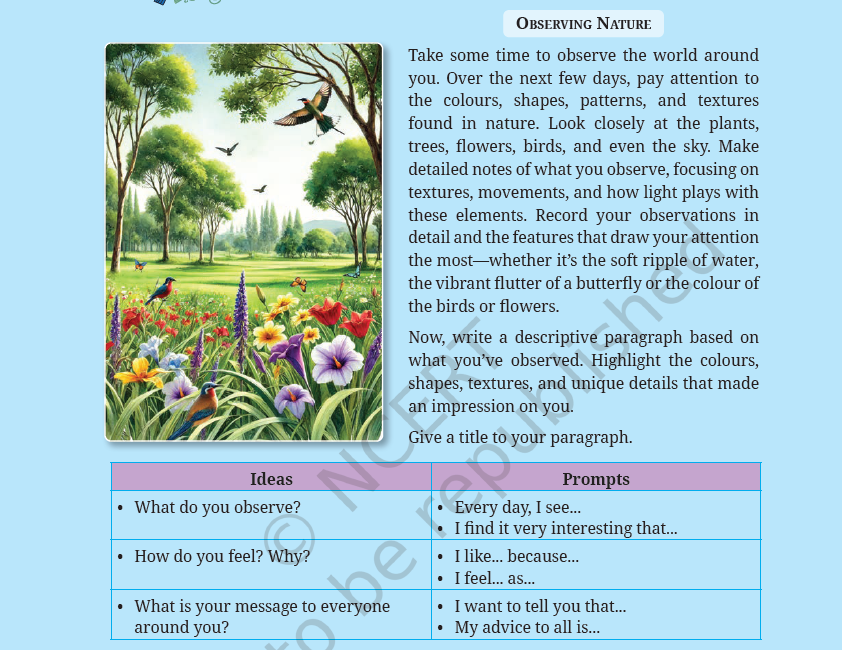
What do you observe? Details specific colors (pink, gold, purple, yellow), textures (rough bark, smooth leaves, velvety petals), and movements (swaying blooms, swift birds).
How do you feel? Why? Expresses a feeling of calm and peace because of the beauty and the feeling of witnessing a “living work of art.”
What is your message? Encourages the reader to pause, observe closely, and appreciate the daily beauty of the natural world.
Title: The Morning’s Vibrant Canvas
Every day, I see the world around me transform as the sun comes up, painting the sky with soft streaks of pink and gold. I find it very interesting that the morning light completely changes how everything looks; the rough, dark brown bark of the tall trees seems to glow, and the smooth, green leaves look incredibly fresh. The garden is filled with vibrant splashes of colour, from the velvety purple petals of the trumpet flowers to the bright yellow blooms swaying gently. I love watching the swift, graceful movements of the colourful birds as they dart between the branches to catch the morning insects. I feel a deep sense of calm as I listen to their cheerful chirping and the soft rustle of the leaves. I like taking the time to notice these small details because it makes the world feel like a living, breathing work of art. I want to tell you that nature offers us a free, beautiful show every single day if we just take the time to look closely. My advice to all is to step outside for just a few moments each day, observe the patterns and textures around you, and let nature’s peacefulness ground you.
Let us explore
I. Discuss why rivers in India are considered to be sacred and most of them are referred to as female. Some rivers are referred to as male, for example, the Brahmaputra and the Sone
The cultural reverence for rivers in India is deeply rooted in the region’s geography, history, and spiritual traditions. Exploring why these water bodies are worshipped, and how they are gendered, reveals a lot about how ancient societies interacted with nature.
Here is a breakdown of why rivers hold such sacred status and the reasoning behind their personifications.
1. Why Rivers are Considered Sacred
In India, rivers are not merely seen as geographical features; they are viewed as living deities and the lifeblood of civilization.
- The Ultimate Sustainer: Historically, India has been an agrarian society. Rivers provided the essential water needed for farming, drinking, and daily survival. Because they sustained life and allowed ancient civilizations (like the Indus Valley and Vedic civilizations) to flourish, they were naturally elevated to a divine, life-giving status.
- Spiritual Cleansing: In Hindu philosophy, rivers are believed to possess purifying properties. Bathing in sacred rivers, particularly the Ganga (Ganges), is thought to cleanse a person of their sins and aid in the cycle of liberation (Moksha).
- Mythological Origins: Almost every major river in India is woven into the fabric of mythology. For example, the river Ganga is believed to have descended from the heavens, flowing through the locks of Lord Shiva to prevent the earth from being shattered by her force. These divine origin stories cement their sacred status.
2. Why Most Rivers are Female
The vast majority of rivers in India—such as the Ganga, Yamuna, Narmada, Godavari, and Kaveri—are personified as female and are often addressed with the suffix Mata (Mother).
- The Nurturing Mother Figure: Rivers exhibit traits traditionally associated with a mother: they nurture, feed, give life, and support growth unconditionally. Just as a mother sustains her child, a river sustains the civilization along its banks.
- Association with Fertility: Rivers bring silt and water that make the soil incredibly fertile. In many ancient cultures, including India’s, fertility, creation, and nature (Prakriti) are fundamentally viewed as feminine energies.
3. The Exceptions: Why Some Rivers are Male
While the nurturing aspect of water is seen as female, a few rivers exhibit characteristics that led ancient people to personify them as male. The most prominent examples are the Brahmaputra and the Sone (Son Bhadra).
- The Brahmaputra (“Son of Brahma”): * Raw Power and Aggression: Unlike the gentle, meandering flow of many plains rivers, the Brahmaputra is characterized by its massive volume, turbulent currents, and roaring sound. It carves violently through the Himalayas.
- Destructive Force: It is notorious for its fierce, unpredictable, and devastating annual floods in Assam. This display of sheer, aggressive physical power and ferocity was culturally interpreted as a masculine trait (Nada) rather than a nurturing feminine one (Nadi).
- The Sone River:
- Swift Currents and Lore: The Sone is a powerful tributary of the Ganga, known for its swift flow and strong currents.
- Mythological Romances: In local folklore, rivers are sometimes given genders to explain their geographical paths. A popular legend states that the male river Sone (Son Bhadra) was to marry the female river Narmada. Due to a misunderstanding involving another river (Johila), Narmada changed her course in anger and flowed westward, while the Sone flowed eastward to join the Ganga.
In essence, the gender assigned to a river in Indian culture typically reflects its physical behavior and the kind of relationship the surrounding people have with it—whether it is one of gentle nurturing or awe-inspiring force.
II Whole Class Activity
- India is a multilingual country, and many of us can speak two to three languages easily. Make a list of the languages that everyone in the class can speak and display it on a chart paper in the classroom
Steps to Conduct the Activity
- Class Brainstorming (The Tally): Draw a rough table on the blackboard. Ask the students to raise their hands and call out the languages they speak at home, with friends, or can comfortably understand.
- Collect the Data: As students name the languages, list them on the board and keep a tally mark next to each language to count how many students speak it.
- Drafting the Chart Paper: Once all the data is collected, transfer this information onto a large piece of chart paper. You can assign this task to a small group of students to encourage teamwork.
2. In which language do you enjoy reading and learning the most?
In Marathi
Page 15: Let us explore (Poster Analysis)
III Read the poster given below and answer the questions that follow.

1. What are the things you can observe in the poster?
Answer: I can observe four young girls sitting together in a row, happily writing and studying.
2. Why do you think the girls look happy?
Answer: They look happy because they are getting the opportunity to attend school, learn, and secure their future.
3. Dignity means ‘self-respect’. What is the relation between ‘dignity’ and ‘happiness’?
Answer: When a person is educated and independent, they earn self-respect (dignity). True happiness often stems from this feeling of worthiness and self-reliance.
4. How does a Nation prosper when its daughters are happy?
Answer: When daughters are educated, respected, and happy, they grow up to become capable individuals who contribute equally to society, the economy, and the overall progress of the nation.
IV. The Government has launched many schemes for the education of the girl child. Some of them
are ‘Beti Bachao Beti Padhao’, ‘Balika Samridhi Yojana’, ‘Samagra Shiksha Scheme – Kasturba
Gandhi Balika Vidyalayas’, etc. Find out more such schemes from the internet or from your
teacher and spread awareness in your neighbourhood
- Sukanya Samriddhi Yojana (SSY): While primarily a small deposit savings scheme under the ‘Beti Bachao Beti Padhao’ campaign, it is specifically designed to help parents build a dedicated fund to meet the future education and marriage expenses of their female children.
- CBSE Udaan Scheme: This project is aimed at addressing the low enrollment of girl students in prestigious engineering institutions. It provides free online educational resources, mentoring, and study materials to girls in Classes 11 and 12 to help them prepare for entrance examinations.
- National Scheme of Incentive to Girls for Secondary Education (NSIGSE): This scheme promotes the enrollment of girls in the 14-18 age group at the secondary school stage. It provides a financial incentive to girls, especially those from disadvantaged backgrounds, who pass Class 8 and enroll in Class 9.
- Pragati Scholarship Scheme (AICTE): Aimed at girls pursuing technical education, this scheme provides financial assistance to thousands of meritorious girl students every year to help them complete their diploma or degree programs.
State-Level Schemes (Maharashtra)
- Lek Ladki Yojana: A highly impactful scheme in Maharashtra offering phased financial aid to girls from families holding yellow and orange ration cards. The assistance is provided in installments from the time the girl is born until she turns 18, actively encouraging parents to keep their daughters in school.
- Majhi Kanya Bhagyashree Scheme: This initiative aims to improve the sex ratio and promote girl child education by providing financial incentives to parents who retain and educate their daughters, effectively replacing older schemes with a more robust support system.
Unit 2: Try Again
Page 19: Let us discuss
I. Complete the summary of the poem by filling in the blanks with suitable words from the text. The poem, written in a narrative style, tells the story of King Bruce of Scotland, who was feeling 1. low to achieve something 2. great for his people. In a moment of 3. despair he observed a spider trying to reach its web high above. The spider 4. tried after failing multiple times. It made nine 5. attempts and finally succeeded. The king said that the spider had 6. conquered and so would he. Inspired by the spider’s determination, King Bruce decided to 7. strive. 8. Tried this time, he ultimately succeeded.
II. Complete the following sentences suitably. 2. The central idea of the poem is that we should never give up in the face of failure; perseverance is the key to achieving our goals.
III. Pick three examples from the poem for each of the following:
- lines that describe the spider’s efforts: “cling and crawl”, “Up, up it ran”, “nine brave attempts were counted”.
- alliteration: “cling and crawl”, “slippery sprawl”, “delicate thread it had to tread”.
IV. Why does the poet repeat the following words or phrases in the poem? (tried and tried; steadily, steadily; up, up)
Answer: The poet repeats these words to emphasize the continuous, relentless effort required to overcome obstacles, showing that progress is often slow but achievable through persistence.
V. Fill in the blanks by choosing the correct answer.
- The rhyme scheme of the poem is ABAB.
- ‘Bravo’ is an example of interjection.
- The poet uses ’twas and ’tis for the sake of rhythm.
Page 20: Metaphors and Similes
1. Read the following sentences and identify metaphors and similes. Write M for metaphor and S for simile.
- (i) He ran as fast as a cheetah. – S
- (ii) The world is a stage. – M
- (iii) The night was as dark as coal. – S
- (iv) He sang like an angel. – S
- (v) Her voice was music to his ear. – M
- (vi) The classroom was a zoo. – M
- (vii) The baby slept like a log. – S
- (viii) Her smile was as bright as the sun. – S
- (ix) The lake was a mirror, reflecting the sky. – M
2. Transform the similes to metaphors and metaphors to similes.
- (iii) The book was a treasure chest, filled with endless adventures.
- Transformed: The book was like a treasure chest, filled with endless adventures.
- (iv) Her laughter was a melody that brightened the darkest days.
- Transformed: Her laughter was like a melody that brightened the darkest days.
- (v) The mountain stood as a guard, watching over the valley below.
- Transformed: The mountain was a guard, watching over the valley below.
- (vi) The night was like a velvet cloak, wrapping the world in mystery.
- Transformed: The night was a velvet cloak, wrapping the world in mystery.
- (vii) Her thoughts were like butterflies in a summer meadow.
- Transformed: Her thoughts were butterflies in a summer meadow.
Pages 21-22: Let us think and reflect
I. Read the extracts given below and answer the questions that follow.
Extract 1: “He flung himself down in low despair…” (i) Select the phrase which shows the physical expression of the King’s emotional state. Answer: “He flung himself down”.
(ii) Why does the poet use the word ‘low’ before despair?
Answer: To emphasize the extreme depth of his sadness, hopelessness, and exhaustion.
(iii) In the line, ‘And after a while he pondered there’, the word ‘pondered’ means:
Answer: B. thought.
(iv) The phrase ‘silken filmy clue’ creates an image of something that is ________.
Answer: very delicate and soft.
Extract 2: “…when it toils so hard to reach and cling…” (ii) List any two characteristics of the spider highlighted in the line, ‘But up the insect went once more’. Answer: Brave and persistent.
(iii) The expression ‘Ah me!’ in the extract indicates a sense of:
Answer: B. stress (or anxiety).
(iv) Complete the sentence with an appropriate reason. Readers are able to relate to this extract because ________
Answer: everyone faces difficult struggles in life where they feel anxious about whether they will ultimately win or lose after putting in hard work.
II. Answer the following questions.
1. How does the first stanza help in setting the mood of the poem?
Answer: It sets a gloomy, melancholic mood by describing King Bruce flinging himself down in a lonely, sinking state of despair.
2. Describe how King Bruce’s attitude changes from the beginning towards the end of the poem.
Answer: He shifts from feeling utterly defeated and ready to “give it all up” to feeling inspired, brave, and determined to strive once more without failing.
3. The poet describes every action of the spider in great detail. What does this tell us about his attitude towards the spider?
Answer: It shows that the poet deeply admires the spider’s relentless perseverance, viewing its tiny, repetitive actions as heroic and worthy of respect.
4. How does the spider inspire us to overcome despair and not give up?
Answer: The spider proves that even a tiny, fragile creature can accomplish great heights against gravity and continuous falls if it simply refuses to quit.
5. The poem teaches us that failures are stepping stones to success. Explain. Answer: Every time the spider fell, it didn’t stay down. It used that failure as a reason to climb again, eventually gaining the ground needed to reach its web. This mirrors how human failures teach us to brace our minds and try again.
6. The spider’s journey tells us that anyone can be a source of inspiration in our lives. Elaborate. Answer: King Bruce was a monarch wearing a crown, yet he found profound wisdom and inspiration from a tiny, seemingly insignificant insect. Inspiration often comes from the most unexpected places if we are willing to observe.
Pages 22-23: Let us learn
I. Write the opposites of the following words taken from the poem.
- up X down
- fast X slow
- glad X sad
- win X lose
- succeed X fail
II. Choose the correct meaning of the underlined words.
- (i) Please make every endeavour to arrive on time. -> an attempt to do something new or difficult
- (ii) Ants toil tirelessly to save food for rainy season. -> work very hard and/or for a long time
- (iii) We encourage all students to strive to do their best. -> to try very hard to achieve something
- (iv) The sailors braced themselves against the strong wind. -> prepared themselves for something difficult
III. Classify the words or phrases based on the distance (far or near).
- Far: remoteness, light year, farther, middle of nowhere, yonder.
- Near: proximity, vicinity, hairline, adjacent, a stone’s throw.
Unit 3: Three Days to See
Page 31: Let us discuss
I. Identify the statements that are true from the ones given below.
- The author expresses a deep longing to experience the world through the sense of hearing. – False (She focuses predominantly on sight).
- The author would like exploring the city only to observe how people are suffering. – False (She wants to see smiles, determination, and suffering alike).
- The author would spend the first day seeing the people whose kind-heartedness and friendship have enriched her life. – True
- The author acknowledges that even in three days, she would not be able to see everything. – True
- The author feels that everyone can find the greatest joy merely by the sense of touch. – False (She states sight must be the most delightful).
- The author advises those who can see to appreciate every moment as if they might lose their senses tomorrow. – True
- On the third day, the author would like to observe people in their daily lives and understand their experiences. – True
Page 32: Let us discuss & Reflect
II. Complete the table given below with what Helen Keller wanted to do on the three days if she had sight.
- Day 1: See the people whose kindness and companionship made her life worth living, know her friends from the feel of their faces.
- Day 2: Arise with the dawn, see the thrilling miracle by which night is transformed into day, visit museums to see the pageant of man’s progress.
- Day 3: Spend in the workaday world, stand at a busy corner, and try to understand the daily lives of people.
III. How is the narrator able to understand the feelings of a person?
Answer: Since she cannot look into their eyes, she understands their feelings by “seeing” through her fingertips—feeling the outline of their faces to detect laughter, sorrow, and other obvious emotions.
I. Read the extracts given below and answer the questions that follow.
Extract 1: “I feel the delicate symmetry of a leaf…” (i) What does the ‘delicate symmetry of a leaf’ symbolise? Answer: It symbolizes the perfection, intricate beauty, and balance found in the natural world.
(ii) List two phrases from the extract that describe the texture of objects in nature.
Answer: “smooth skin of a silver birch” and “rough, shaggy bark of a pine”.
(iii) The phrase ‘awakening Nature after her winter’s sleep’ refers to:
Answer: the beginning of spring when plants sprout new buds.
(iv) What is the tone of the writer in this extract?
Answer: C. admiring.
Extract 2: “The next day I should arise with the dawn…” (i) Which of the following words does not match with the word ‘thrilling’? Answer: C. knowledge (Experiences, tales, and adventures can be thrilling, but ‘thrilling knowledge’ is an uncommon pairing).
(ii) Why does the writer refer to the earth as ‘sleeping earth’?
Answer: She refers to it as sleeping because it is the dark, quiet time right before the dawn brings light and activity to the world.
(iii) The writer wishes to dedicate the day to a brief look at the present and past world because ________
Answer: she only has three short days of imagined sight and wants to capture the massive scale of human and natural history as quickly as possible.
(iv) Why does the writer use ‘should’ multiple times in the extract?
Answer: She uses ‘should’ to clearly express her strong desires and the hypothetical plans she would execute if she were granted the gift of sight.
II. Answer the following questions.
1. The sense of touch makes up for the loss of sight and hearing. Explain this statement with reference to the text. Answer: The author uses her hands to feel the intricate symmetry of leaves, the rough bark of trees, and even the vibration of a singing bird. Through mere touch, she finds hundreds of interesting things that give her immense pleasure and connection to the world.
2. Why does the author believe that the sense of sight is the most wonderful?
Answer: She reasons that if she can extract so much joy and detail from merely touching objects, the beauty and complexity revealed by actually seeing them must be overwhelmingly magnificent.
3. How might the author’s opinion on making the most of our senses guide us to be kinder towards people with special abilities? Answer: Her perspective reminds us not to take our abilities for granted. It builds empathy, helping us realize how challenging yet profound the lives of those with sensory impairments are, prompting us to be more inclusive and compassionate.
4. What is the significance of imagining the loss of a sense, according to the author? Answer: Imagining the loss of a sense acts as a wake-up call. It forces people to stop taking their abilities for granted and to start truly appreciating and noticing the vibrant details of the world around them.
5. How does the author encourage people to approach their everyday sensory experiences?
Answer: She advises people to use their eyes as if they would be stricken blind tomorrow, to listen to music as if they would go deaf, and to touch, smell, and taste with extreme relish, treating every sensory input as a fleeting gift.
6. What do the author’s choices for the three days tell us about her values and priorities?
Answer: Her choices—focusing first on loving friends, then on the marvels of history and nature, and finally on the everyday struggles and joys of common people—show that she highly values human connection, knowledge, and deep empathy.
Pages 34-35: Let us learn (Vocabulary & Grammar)
I. Sensory Words Table
- What you see: panorama, glimpse, sight * What you hear: music, song, strains
- What you smell: perfume, fragrance
- What you taste: relish, morsel
- What you feel: rough, smooth, shaggy, delicate
III. Identify the modal verbs and choose their functions.
- You can learn a lot from this experience. -> ability
- They might arrive late due to traffic. -> possibility
- She must finish her homework before dinner. -> necessity
- They ought to apologise for their mistake. -> moral obligation
- He would like to have some lassi, please. -> polite request
IV. Fill in the blanks with appropriate modal verbs.
- (i) May / Can I leave early today if I finish all my tasks?
- (ii) I must finish this by tomorrow.
- (iii) You should consider all the pros and cons before making a decision.
- (iv) It might / may rain later today.
- (v) Would / Could you pass the salt, please?
- (vi) You ought to / should apologise for the mistake you made.
- (vii) We can / could go to any park nearby for picnic.