
Match the animals to the name of their groups
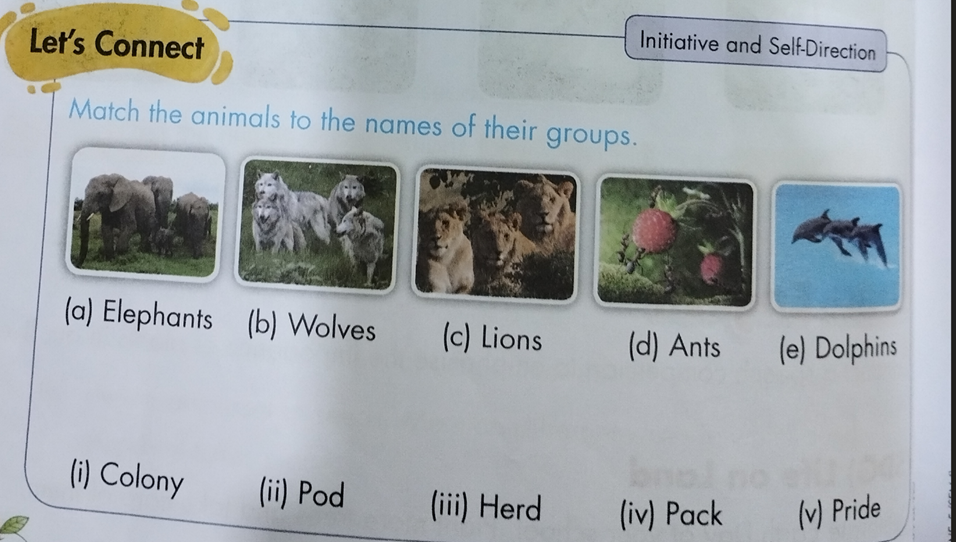
•(a) Elephants – (iii) Herd
•(b) Wolves – (iv) Pack
•(c) Lions – (v) Pride
•(d) Ants – (i) Colony
•(e) Dolphins – (ii) Pod
Let’s Practise
1. Match the following:
| Column A | Column B |
| (a) Herbivores | (iv) Eat plants |
| (b) Carnivores | (iii) Eat flesh |
| (c) Omnivores | (ii) Eat both plants and animals |
| (d) Scavengers | (i) Eat dead animals |
2. Answer in one word.
(a) Long winter sleep
Answer: Hibernation
(b) An ability of animals to merge with their surroundings
Answer: Camouflage
(c) A thick layer of fat below the skin of a polar bear
Answer: Blubber
(d) The organisms that live on and inside the body of other organisms
Answer: Parasite
3. Fill in the blanks.
(a) In water, frogs breathe through moist skin.
(b) Animals that fly in air are called aerial animals.
(c) Animals that live both in water and on land are called amphibians.
(d) Arboreal animals live on trees.
4. Choose the correct option.
(a) (Arboreal) animals have strong arms and legs to climb trees.
(b) Birds have hollow bones.
(c) The movement of birds from one place to another to avoid harsh weather conditions is called migration.
(d) The chameleon blends in with its surroundings.
5. Write ‘T’ for True and ‘F’ for False.
(a) The polar bear stores fat in the hump. — F
(b) Winter sleep is called hibernation. — T
(c) The grasshopper camouflages with its surroundings. — T
(d) The camel stores food in the blubber. — F
6. Short Answer Questions
(a) What is adaptation?
Answer: Adaptation is the special feature that animals develop to live in different environmental conditions for survival.
(b) How are camels adapted to live in the desert?
Answer: Camels can live without water and food for several days. They store fat in their hump, have thick skin, long legs with padded soles, and long eyelashes to protect from sand.
(c) List the adaptations of arboreal animals.
Answer: They have strong arms and legs to climb trees, stout chest, broad hip girdle, and sometimes long tails for gripping branches.
(d) What is aestivation?
Answer: Aestivation is a summer sleep in animals to survive hot conditions by resting in cool, shady places.
(e) What are parasites? Give two examples.
Answer: Parasites are organisms that live on or inside other organisms for food. Examples: lice, ticks.
(f) Define scavengers and herbivores.
Answer: Scavengers eat dead animals (e.g., vultures). Herbivores eat only plants (e.g., goat, cow).
7. Long Answer Questions
(a) Explain the adaptive features of aquatic and terrestrial animals with examples.
Answer:
•Aquatic animals like fish have fins, streamlined bodies, and gills for breathing underwater.
•Terrestrial animals like lions and tigers have lungs to breathe, strong legs to run, and well-developed sense organs.
(b) Describe the adaptations for protection in animals.
Answer:
•Animals like deer run fast, tortoises have shells, porcupines have spines, and rhinoceroses have horns.
•Some animals use camouflage like chameleons and stick insects.
•Animals like cuttlefish release ink, and others live in groups for protection.
Think Beyond – Critical Thinking
1. Give reasons for the following:
(a)Why do birds have wings?
Answer: Birds have wings to help them fly and move through the air.
(b) Why do camels have humps?
Answer: Camels have humps to store fat, which helps them survive without food for days.
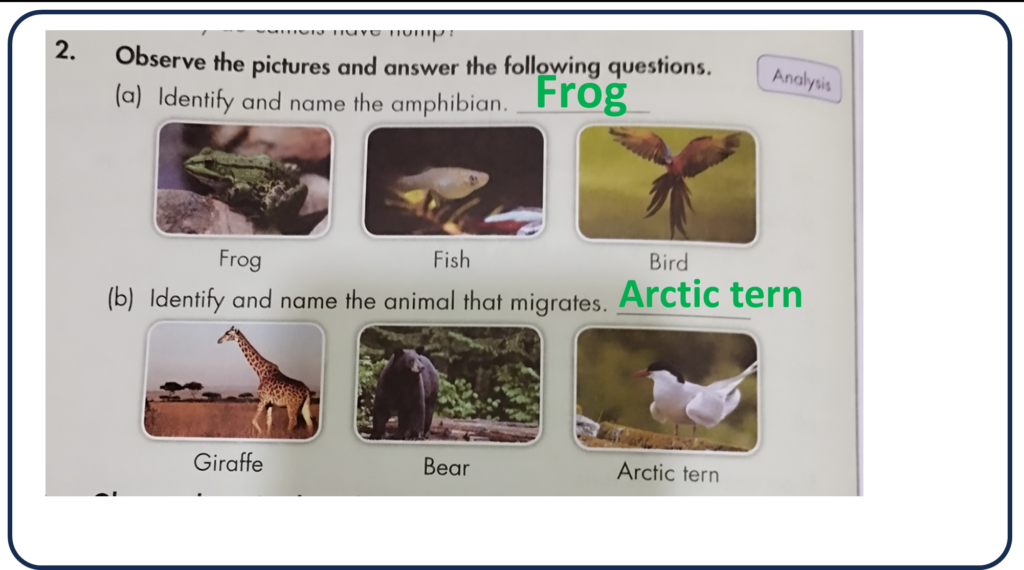
3. Observe the animals and write their adaptation with reason.
| Animal | Habitat | Adaptation | Reason |
| (a) Cheetah | Grassland | Spots on the fur | To camouflage |
| (b) Monkey | Forest | Long tail and strong limbs | To climb and swing on trees |
| (c) Polar bear | Cold region | Thick fur and blubber | To keep warm and survive in cold |
| (d) Camel | Desert | Hump, padded feet | To store fat and walk on sand |
Let’s Test Your Skills Critical Thinking
Choose the correct option.
1. Rohit observed the eating habits of an organism ‘Y’ that lived on or inside another organism. Which animal can ‘Y’ be?
(a) Herbivore
(b) Parasite
(c) Scavenger
(d) Carnivore
2. Ritu made a note about the eating habits of an animal ‘X’. Animal ‘X’ eats plants. Which animal can ‘X’ be?
(a) Snake
(b) Goat
(c) Frog
(d) Fish