
1) Match the following
| Column A | Column B |
| (a) Seed coat | (i) Cotyledons |
| (b) Seed leaves | (ii) One cotyledon |
| (c) Monocot | (iii) Baby plant |
| (d) Embryo | (iv) Outer covering |
Answer:-
| Column A | Column B |
| (a) Seed coat | (iv) Outer covering |
| (b) Seed leaves | (i) Cotyledons |
| (c) Monocot | (ii) One cotyledon |
| (d) Embryo | (iii) Baby plant |
2. Answer in one word:
(a) A plant that grows from underground stem Potato
(b) A plant that reproduces from leaves Bryophyllum
(c) A plant that reproduces from spores Fern
(d) A plant that reproduces from the cutting of the stem Rose.
3. Fill in the blanks:
(a) Bryophyllum has special buds on the margin of the leaves.
(b) The tiny baby plant inside the seed is called embryo.
(c) Dandelion seeds are dispersed through wind.
(d) The process of growth of seed into seedling is called germination.
4. Choose the correct option:
(a)The (Cotyledon / Seed coat) of a seed contains stored food for the baby plant.
Answer:- The cotyledon of a seed contains stored food for the baby plant.
(b) The fruits of (pea / cotton) burst with great force for scattering the seeds.
Answer:- The fruits of pea burst with great force for scattering the seeds.
(c) The baby plant formed after germination is called (seedling / embryo).
Ans:-The baby plant formed after germination is called seedling.
(d) Plants like ferns and mosses are called (flowering / non-flowering) plants.
Answer:- Plants like ferns and mosses are called non-flowering plants.
5. Write ‘T’ for True and ‘F’ for False:
(a) Dispersal is the process of growth of seed into a new plant. False
(b) Cotyledon provides nutrition for the growing baby plant. True
(c) Monocot plants are those that have only two cotyledons. False
(d) A small shoot that emerges from the seed and grows upwards is cotyledon. False
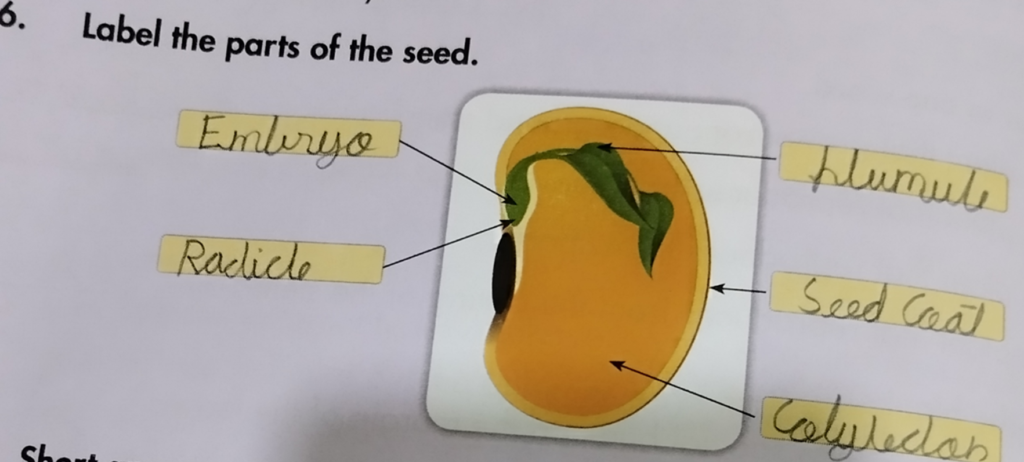
7. Short Answer Questions:
(a) Define germination.
→ The process by which the seed grows into a seedling is called germination.
b. List the different parts of a seed.
→ A seed mainly consists of three parts: seed coat, seed leaves, and an embryo.
c. Write the necessary conditions for the germination of a seed.
→ The necessary conditions for the germination of the seed are the right amount of water, air, and sunlight.
Long Answer
1) Draw and explain the structure of a seed.
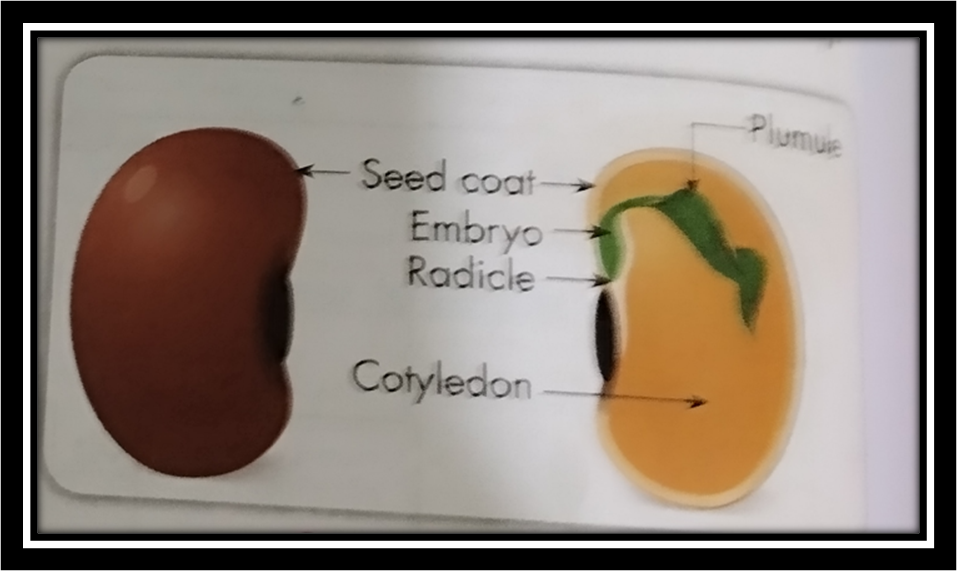
(a) Seed coat: The outermost layer of the seed is called the seed coat. It protects the baby plant until the seed germinates.
(b) Seed leaves (Cotyledons): Inside the seed coat, seed leaves or cotyledons are present. They store food for the growing embryo.
(c) Embryo: A baby plant present inside the seed leaves is called an embryo.
It has two parts:
The radicle that grows into the root, and
The plumule that grows into the shoot.
2) Explain any two methods of vegetative reproduction in plants.
Ans: i. Plants like carrot, radish, sweet potato, and dahlia reproduce through their roots. A new plant can grow from the roots of the parent plant.
ii. Plants like rose, hibiscus, and money plant can grow into new plants from small cuttings of stems taken from the parent plant.
iii. Plants like Bryophyllum have special buds on the margin of the leaves. When these buds fall on fertile soil, they grow into new plants.
3) Define dispersal of seeds.
Ans:
The process by which seeds are scattered away from the parent plant is called the dispersal of seeds.
The different ways in which seeds are dispersed are:
i. Dispersal by wind – e.g., cotton, dandelion
ii. Dispersal by water – e.g., coconut, lotus
iii. Dispersal by animals – e.g., xanthium, tiger nail
iv. Dispersal by explosion – e.g., balsam, okra