Chapter 7 Mensuration Class 10 Maharashtra Board TextBook Solution
Practice set 7.1 | Q 10 | Page 145
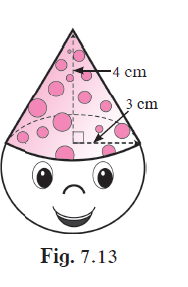
Figure 7.13 shows
a toy. Its lower part
is a hemisphere
and the upper part
is a cone. Find the
volume and the
surface area of the
toy from the
measures shown in
the figure.(p= 3.14)
Answer:-
The given toy consists of a hemisphere and a cone with the same radius (r = 3 cm) and the height of the cone (h) is 4 cm. The slant height of the cone (l) is calculated using the Pythagorean theorem, which turns out to be 5 cm.
Using the formulas for the volume and curved surface area of the cone and hemisphere, we can calculate the volume and surface area of the toy.
The volume of the cone is calculated as 12π cm³ and the curved surface area of the cone is calculated as 15π cm². The volume of the hemisphere is calculated as 18π cm³ and the curved surface area of the hemisphere is calculated as 18π cm².
Therefore, the total volume of the toy is 30π cubic centimeters (which is approximately 94.20 cm³) and the total surface area of the toy is 33π square centimeters (which is approximately 103.62 cm²).
Solution
Given that the toy consists of a hemisphere and a cone with the same radius $$r = 3$$ cm and the height of the cone $$h = 4$$ cm. The slant height of the cone $$l$$ is calculated using the Pythagorean theorem:
$$l = sqrt{r^2 + h^2} = sqrt{3^2 + 4^2} = sqrt{9 + 16} = sqrt{25} = 5 text{ cm}$$
The volume of the cone is given by the formula:
$$text{Volume of cone} = frac{1}{3} pi r^2 h$$
Substituting the given values, we get:
$$text{Volume of cone} = frac{1}{3} pi (3^2)(4) = 12pi text{ cm}^3$$
The curved surface area of the cone is given by:
$$text{Curved surface area of cone} = pi rl$$
Substituting the values, we get:
$$text{Curved surface area of cone} = pi (3)(5) = 15pi text{ cm}^2$$
The volume of the hemisphere is given by the formula:
$$text{Volume of hemisphere} = frac{2}{3} pi r^3$$
Substituting the given value, we get:
$$text{Volume of hemisphere} = frac{2}{3} pi (3^3) = 18pi text{ cm}^3$$
The curved surface area of the hemisphere is given by:
$$text{Curved surface area of hemisphere} = 2pi r^2$$
Substituting the value, we get:
$$text{Curved surface area of hemisphere} = 2pi (3^2) $$$$= 18pi text{ cm}^2$$
Hence, the total volume of the toy is given by:
$$text{Total volume} = text{Volume of cone} + text{Volume of hemisphere} $$$$= 12pi + 18pi $$$$= 30pi approx 94.20 text{ cm}^3$$
The total surface area of the toy is given by:
$$text{Total surface area} = text{Curved surface area of cone} + text{Curved surface area of hemisphere} $$$$= 15pi + 18pi $$$$= 33pi approx 103.62 text{ cm}^2$$
Therefore, the volume and surface area of the toy are approximately$$ 94.20 text{cm}^3$$ and $$103.62 text{cm}^2$$ respectively.
Chapter 7 Mensuration Textbook Solution 7.1
Practice set 7.1
Click Here for all Textbook Answers of Chapter 7 Mensuration