
A.Picture-based questions.
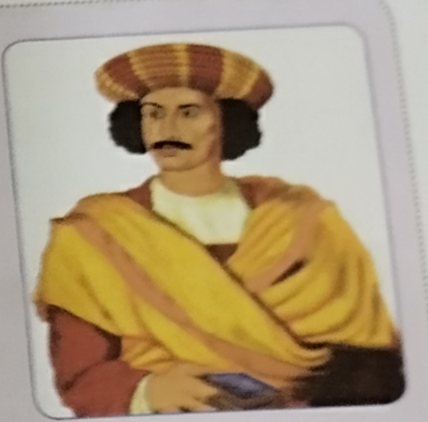
1. Identify the reformer and write about his contribution.
The reformer in the image is Raja Ram Mohan Roy.
📝 His Contributions:
•Founder of Brahmo Samaj: He founded the Brahmo Samaj in 1828 to promote monotheism and reform social practices.
•Abolition of Sati: He strongly opposed the practice of sati (burning of widows) and was instrumental in getting it banned in 1829 by the British government.
•Advocated Women’s Rights: He promoted education for women and widow remarriage.
•Modern Education: He supported the use of English education and modern subjects like science and mathematics.
•Social Reformer: Fought against child marriage, caste discrimination, and superstitions.
🅑 True or False Statements
1.The Doctrine of Lapse was introduced by Lord Dalhousie.
✅ True
2.The Revolt of 1857 started in Lucknow.
❌ False – It started in Meerut.
3.The Indian National Congress was formed by Jawaharlal Nehru.
❌ False – It was formed by A.O. Hume.
4.The Revolt of 1857 is called the First War of Independence.
✅ True
5.The British forced the farmers to grow cash crops.
✅ True
C. Choose the Correct Option
1. The East India Company’s rule ended in:
A) 1856
B) 1857
C) 1858
D) 1860
✅ Answer: C) 1858
2. The Great Revolt is also known as:
A) Indian War
B) Sepoy Mutiny
C) Quit India Movement
D) Jallianwala Bagh
✅ Answer: B) Sepoy Mutiny
3. ______ formed the Indian National Congress (INC):
A) Gandhiji
B) Jawaharlal Nehru
C) A.O. Hume
D) Subhash Chandra Bose
✅ Answer: C) A.O. Hume
Answer The following Questions
1. The trade in India was very profitable for the British. How? Explain.
India was known for its rich resources, especially spices, cotton, silk, gold, and pearls. European countries like Portugal, Netherlands, and England came to India for trade.
The British East India Company, formed in 1600 CE, set up factories and began trading goods at cheap rates in India and sold them at higher prices in Europe and America. This resulted in huge profits for the British while Indian craftsmen and weavers were pushed into poverty.
2. How did the British exploit the farmers?
•The British forced farmers to grow cash crops like cotton and indigo instead of food crops.
•Farmers had to pay heavy taxes even during natural calamities like droughts and floods.
•The British discouraged the establishment of Indian factories and industries.
•Farmers could not sell their handmade products as they had to buy British-manufactured goods.
This system of exploitation left Indian farmers impoverished and powerless.
3. The Subsidiary Alliance was a policy introduced by Lord Wellesley.
According to this policy:
•Indian rulers had to keep British soldiers in their kingdom.
•They had to pay for the maintenance of the British army.
•The Indian kings gradually lost their independence and came under British control.
4. Write the factor that triggered the First War of Independence.
The immediate trigger was the introduction of the Lee-Enfield rifle:
•The cartridges were greased with cow and pig fat.
•This hurt the religious sentiments of both Hindus and Muslims.
•A soldier named Mangal Pandey attacked a British officer in protest.
•On 10 May 1857, the revolt began in Meerut and spread across cities like Delhi, Kanpur, Lucknow, and Jhansi.
This revolt is known as the Revolt of 1857 or First War of Independence.
5. Who introduced the Doctrine of Lapse and why?
The Doctrine of Lapse was introduced by Lord Dalhousie.
According to this policy:
•If a king died without a natural heir (biological son), his kingdom would be taken over by the British.
•Example: After the death of Rani Lakshmibai’s husband, the province of Jhansi was annexed.
This policy created widespread resentment and anger among Indian rulers.