
1. Multiple-choice questions (MCQs)
Tick (✓) the correct option.
(a)Plants growing in hilly areas and mountains have the following adaptations:
(i)Needle-shaped leaves (ii) Waxy coating
(iii) Sloping branches (iv) All of these
✅ (iv) All of these
(Needle-shaped leaves, Sloping branches, Waxy coating — all help adapt to cold and snow.)
b) Which of the following has breathing roots?
(i)Pine (ii) Mangrove
(iii) Banyan (iv) Both (i) and (iii)
✅ (ii) Mangrove
(c) In which season do trees in the plains shed their leaves?
(i)Summer (ii) Winter
(iii) Rainy (iv) Autumn
✅ (ii) Winter
(d) Which of the following is a parasitic plant?
(i)Pitcher plant (ii) Cuscuta
(iii) Venus flytrap (iv) None of these
✅ (ii) Cuscuta
2. Fill in the blanks
2. Fill in the blanks
(a) Cedar is an example of a tree that grows in hilly areas.
(b) Places which have sticky and clayey soil and plenty of water are known as marsh land.
(c) venus fly trap trap insects with the help of specially designed leaves.
(d) Aquatic plants have special adaptive features to help them float or stay underwater.
3. Write ‘T’ for true and ‘F’ for false.
(a) Plants like jute and flax are used for making medicines. – ❌ F
(They are used for making fiber, not medicines.)
(b) Water hyacinth and Wolffia are floating plants. – ✅ T
(c) Peepal has thin and broad leaves to capture sunlight for photosynthesis. – ✅ T
(d) Plants in deserts have cones instead of flowers. – ❌ F
(They do have flowers, but often small; some may have thorns or spines.)
(e) Cuscuta is an insectivorous plant. – ❌ F
(It is a parasitic plant, not insectivorous.)
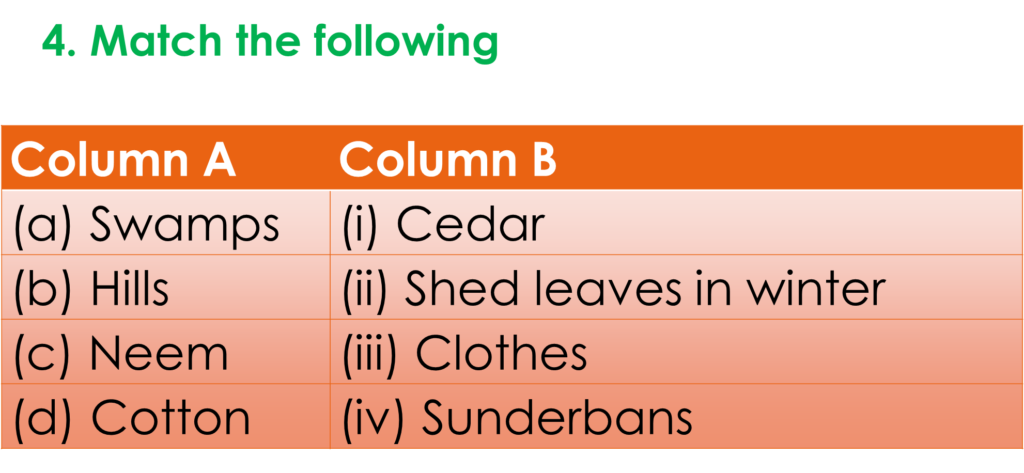
Answer:-
| Column A | Column B |
| (a) Swamps | (iv) Sunderbans |
| (b) Hills | (i) Cedar |
| (c) Neem | (ii) Shed leaves in winter |
| (d) Cotton | (iii) Clothes |
5. Read the following two statements and choose the correct option
Statement 1 – Tape grass has narrow, thin, ribbon-like leaves.
Statement 2 – Hydrilla leaves have no stomata.
a)Both statement 1 and 2 are correct
b)Statement 1 is correct but statement 2 is incorrect
c)Statement 1 is incorrect but statement 2 is correct
d)Both statements are in correct.
Statement 1 – Tape grass has narrow, thin, ribbon-like leaves. ✅ (Correct)
Statement 2 – Hydrilla leaves have no stomata. ❌ (Incorrect — Hydrilla has stomata on the upper surface only)
✔️ Correct option: (b) Statement 1 is correct but statement 2 is incorrect.
6. Short answer type questions
(a) Define adaptation.
Answer:
Adaptation is the special characteristic that allow a plant or an animal to live in a specific environment.
(b) Why does tape grass have narrow and thin leaves?
Answer:
In order to offer least resistance to water tape grass have narrow and thin leaves.
(c) Write two adaptations of desert plants.
Answer:
1. Plants in desert have either no leaves or very few leaves to prevent water loss from the surface of leaves.
2.Plants in desert have well develop long roots to absorb water from deep soil.
(d) What are breathing roots?
Answer:
The roots of some plants come out of water and soil to breath. These are called breathing roots
Que 6. Long answer type question.
1)What are the four categoris of terrestrial plants?
Ans:- Two categories of terrestrial plants are
i)Plants in hills :
a)Plants that are growing in the hills have needle shaped little leaves with waxy coating.
b)Trees such pine, cedar , fir etc. growing in hilly area.
ii)Plants in plains.
a)Such plants have thin and broad leaves.
b)Tree such as mango, banyan, peepal and neem growing in plains
2) How do parasitic plants derive their food?
Answer:- Parasitic plant like Cuscuta can photosynthesis partially and thus can not produce all of their food. They are non green plants